The Honolulu Rail Transit Project was slated to cost $5.2 billion. That figure has doubled as construction progresses, leaving the city scrambling for funds amid public outcry.


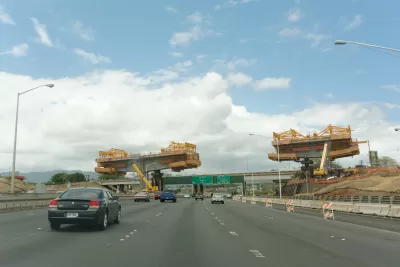
There's a lot of trouble afoot for Honolulu's attempt at traffic-easing transit. Brittany Lyte writes, "In a bid to unsnarl its highways a bit in 2011, the city embarked on a $5.2 billion Honolulu Rail Transit Project. At the time, the planned 20-mile elevated electric train line was expected to ease traffic congestion on Hawaii's most densely populated island by 18 percent, with the first trips planned for 2017."
Six years on, costs have ballooned to $10 billion and rising. "Per capita, the Honolulu rail could become the most expensive transit project in U.S. history, according to the conservative public policy think tank Grassroot Institute of Hawaii."
Will the hugely expensive undertaking actually justify its costs? Estimates say no, predicting only a few percentage points of decreased traffic amid a net increase. Local politicians, including Democrats, are calling for a stop to the bleeding via the withdrawal of federal support, but others feel it's already too late.
Lyte points to transit projects in New Jersey and Maryland that were scuttled due to financial strain and legal challenges.
Read the full story: Honolulu's Rapid Transit Crisis
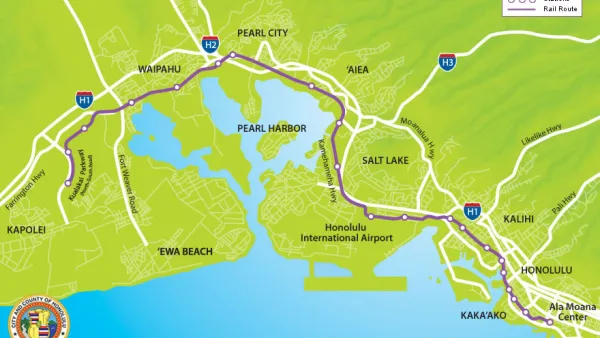
Federal Subpoenas for Honolulu Authority for Rapid Transportation
Bad news for Honolulu's troubled rail transit project: new federal scrutiny and a potential criminal investigation.
Honolulu Rail Transit Makes Progress Despite Financial Woes
Honolulu Rail Transit, a 20-mile, elevated metro rail line, continues to suffer cost overruns and has lost popular support, according to a recent poll. But the tide could change with the arrival of the first rail cars.
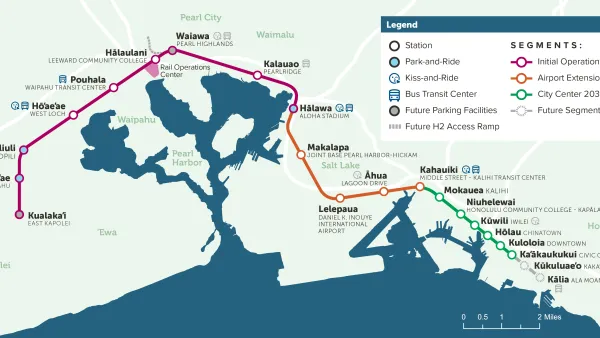
Skyline Rail, Now Serving Honolulu
In a historic day for public transit, Skyline Rail, a project once deemed the worst transit project in the United States due to extreme cost overruns and construction delays, finally opened to the public at the end of June.

Planetizen Federal Action Tracker
A weekly monitor of how Trump’s orders and actions are impacting planners and planning in America.

California plans to bury El Niño’s downpour
If the state plays its cards right, it may be able to store a billion acre-feet of El Niño’s water in aquifers.

Desperate measures: Advocates weigh draining Lake Powell to fill Colorado River
Draining the reservoir could reduce evaporation losses by a couple hundred thousand acre-feet.

Mamdani’s pied-à-terre tax survives legal challenge
A panel of judges found that the plaintiffs failed to demonstrate injury as a result of New York City's implementation of the tax.

Eastern Nebraska is running out of electricity
Data centers and electrification are straining eastern Nebraska’s grid, throttling economic development.

Seattle passes record-breaking transit services expansion
Proposition 1 will double the city’s transit tax to add 95,000 more bus trips and preserve 180,000 bus trips annually.

FREE Course: Walkable City 1: Why Walkability?
After describing his path towards focusing on walkability as the essence of good planning, Jeff Speck marches through his five principal reasons for making more walkable places.
Reinventing Malls: Planning Alchemy—Turning Gray Fields Into Gold
The course focuses on the opportunities and imperatives that shape reinvention of mall sites.

City of Rosemead
Rutgers University, Edward J. Bloustein School of Planning and Public Policy
One Hundred Miles
Hunter College, City University of New York (CUNY)
The Architects Foundation
University of Cincinnati Online
City of Cambridge
Montrose County
The Pocatello Development Authority