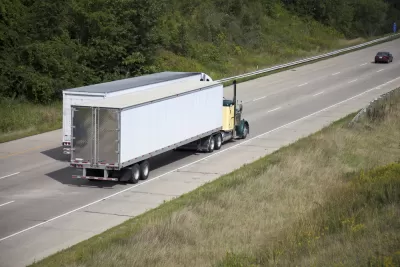
A mileage fee applicable only to heavy trucks is floated as a third option to close the road funding gap in Wisconsin. The other two options are hiking gas taxes, which is opposed by Gov. Scott Walker, or adding road tolls.


"GOP disagreements on transportation are holding up the state budget," reports Jason Stein for the Milwaukee Journal Sentinel. And it's not just a partisan issue in the Republican-controlled legislature.
Assembly Republicans want to raise taxes on gasoline to help pay for highways and hold down borrowing but Walker and many Senate Republicans oppose increases on gas taxes or registration fees.
Walker had backed increasing the gas tax, notes a February 2015 post, until he became a presidential candidate.
Democrats support raising the 32-cents per gallon gas tax [pdf], but oppose the Republican plan which would offset the gas tax increase "by deeply cutting income taxes, which pay for other services such as education and health care," reported Stein and Patrick Marley for the Journal Sentinel on June 7.
Road tolls
The second option, supported by Republicans in the Assembly and the Senate along with Gov. Walker, would add road tolls, but in a legally questionable manner by only tolling border areas. The idea is to largely toll out-of-state motorists.
"If (Wisconsin drivers) saw some relief and the people coming out of Chicago or Rockford or elsewhere helped where they're used to that — again I'm not promoting that — but that's something we could live with," Walker said.
In addition to the possible legal objections (see a 2013 review by the Congressional Research Service [pdf]), the tolling infrastructure would also be costly, and a federal waiver would be needed to toll interstate highways. A less controversial application would have political merit though. A 2014 Marquette University Law School poll showed greater support for road tolls than increasing gas taxes.
New heavy truck fee
The proposal is being floated by Rep. Amy Loudenbeck (R-Clinton) and is already done by Kentucky, New York, New Mexico, and Oregon, according to Loudenbeck. "Wisconsin could mimic the approach of one of those states and be on firm legal ground, she said," reports Stein.
If Wisconsin adopted Kentucky's 2.85 cents per mile fee [called a weight distance tax], it would raise more than $250 million for the state over two years and cost truckers or their customers the same amount, Loudenbeck said.
Rep. John Nygren (R-Marinette) and Assembly Speaker Robin Vos (R-Rochester) have talked with Loudenbeck about her idea and haven't ruled it out.
The fee has merit as heavy trucks cause disproportionate wear to roads and bridges.
Road Damage and Vehicle type/weight

Credit: streets.mn
Stein reports that trucking companies might not necessarily be opposed to the fee as some may see it as preferable to new tolls. In addition, implementation may not be that difficult "because trucking companies that cross state lines already track their miles traveled as part of a fuel tax compact between the U.S. and Canada," writes Stein.
One notable exception to that would be truckers who only haul loads inside Wisconsin. They would need to start tracking that information.
"I think this could be part of a broader solution as a revenue generator that's equitable and sustainable," said Loudenbeck.
Just hike the gas tax!
"Sen. Jon Erpenbach of Middleton, a Democrat on the budget committee, said Republicans should stop looking at unusual options for funding roads and simply raise the existing tax on gasoline," adds Stein.
"This underscores how far they're willing to go to not raise the gas tax," he said.
Hat tip to AASHTO Daily Transportation Update.
FULL STORY: Per mile fee on heavy trucks emerges as tolling alternative for Wisconsin road funding

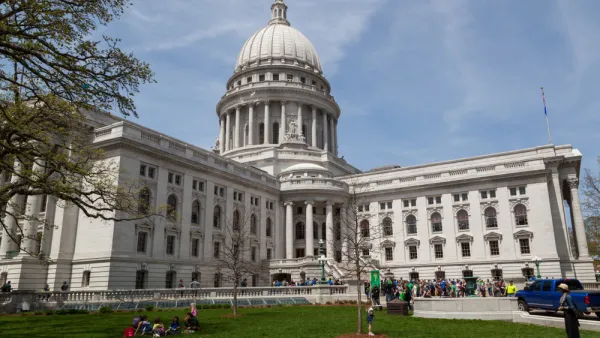
Wisconsin Republicans Unite to Support Road Tolling Over Gas Tax Hike
Assembly and Senate Republicans agree that the best way to fill the transportation funding gap is to add tolls to existing highways and bridges, yet they won't add toll infrastructure funding to the budget. A gas tax could be implemented immediately.
Report Supports Road Tolls and VMT Fees over Gas Tax
The Congressional Budget Office takes aim at transportation funding and spending. It notes with alarm a $143 billion federal subsidy since 2008 and recommends charging motorists directly via vehicle-miles-traveled fees and road tolls.
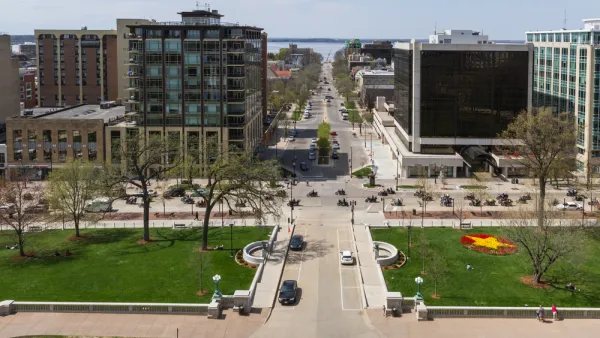
Wisconsin Gov. Tony Evers Proposes Gas Tax Hike
The eight-cents-per-gallon gas tax increase is one of several measures in the Democrat governor's first budget that marks a major departure from the the tenure of former Republican Gov. Scott Walker.

Planetizen Federal Action Tracker
A weekly monitor of how Trump’s orders and actions are impacting planners and planning in America.

The state-sanctioned urbicide of Austin
People don’t kill cities. Freeways do.

US to reduce Colorado River water deliveries to Mexico
A new Colorado Treaty amendment reduces Mexico’s Colorado River water allocation by 250,000 acre feet.

Mamdani overhauls NYC's Vision Zero plan with 100 new policy goals
The overhaul aims to reduce traffic deaths and make streets safer for pedestrians, cyclists and drivers through lower speed limits, new safety infrastructure and more.

Amtrak not solely to blame for New Jersey commuter rail's unreliability, report finds
A new study from the Garden State Initiative found that NJ Transit’s budget grew 20% across a 4 year period, but reliability declined significantly over the same period.

EPA erases limits on planet-warming pollution from power plants
Under Monday’s plan, power plants would still have some limits on how much mercury, arsenic and other contaminants they can emit.

FREE Course: Walkable City 1: Why Walkability?
After describing his path towards focusing on walkability as the essence of good planning, Jeff Speck marches through his five principal reasons for making more walkable places.
Reinventing Malls: Planning Alchemy—Turning Gray Fields Into Gold
The course focuses on the opportunities and imperatives that shape reinvention of mall sites.

Eagle County Government
Harvard University Graduate School of Design
Nashville Planning Department
The Architects Foundation
University of Cincinnati Online
The Pocatello Development Authority
The Urban Renewal Agency of the City of Pocatello
Journal of the American Planning Association