States and cities are reacting to President Trump's withdrawal from the Paris Climate Agreement on Thursday. Three states formed the U.S. Climate Alliance; by Monday, it had grown to 13. Initially 30 mayors signed in support; it's now over 200.


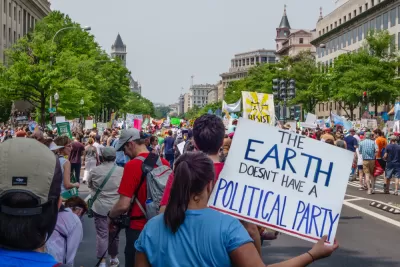
"In response to President Trump’s decision to withdraw from the Paris Climate Agreement, New York Governor Andrew M. Cuomo, California Governor Edmund G. Brown Jr., and Washington State Governor Jay R. Inslee today announced the formation of the United States Climate Alliance, a coalition that will convene U.S. states committed to upholding the Paris Climate Agreement and taking aggressive action on climate change," states the June 1 joint press release by the three Democratic governors.
New York, California and Washington, representing over one-fifth of U.S. Gross Domestic Product, are committed to achieving the U.S. goal of reducing emissions 26-28 percent from 2005 levels and meeting or exceeding the targets of the federal Clean Power Plan [now being dismantled by Trump administration by executive order].
By June 3, the alliance had grown to nine states, reported Marykate Jasper for The Mary Sue, a Mediaite blog. Joining the initial three states were: Connecticut, Hawaii, Massachusetts, Oregon, Rhode Island and Vermont.
While predominantly composed of Democratic governors, the alliance is bipartisan, including Republican Governors Phil Scott of Vermont and Charlie Baker of Massachusetts.
On Monday (June 5), Democratic Governor Terry McAuliffe of Virginia announced he was joining, along with the governors of Delaware, Minnesota and Puerto Rico, according to the alliance.
"Delaware is the country’s lowest-lying state and with 381 miles of coastline, climate change is a very real threat to our future," said Delaware Governor John Carney. "As sea levels rise, more than 17,000 Delaware homes, nearly 500 miles of roadway and thousands of acres of wildlife habitat including our critical wetlands are at risk of permanent inundation."
"Puerto Rico, an Island that 3.4 million American Citizens call home, would suffer greatly from the devastating effects of rising sea levels," stated Puerto Rico Governor Ricardo Rosselló Nevares who is also a scientist. "But we all stand to lose if we don't take meaningful action right now."
An effort is underway in New Jersey by state "Sen.Bob Smith, a Democrat who chairs the Senate Environment and Energy Committee, and his [Democratic] colleague, Sen. Linda Greenstein" to join the alliance, reports Tom Johnson for NJ Spotlight on June 5. It became a campaign issue when "Phil Murphy, the frontrunner for the Democratic gubernatorial nomination, pledged to join the alliance if he is elected governor."
Cities
Initially there were 30 mayors who were supporting the alliance, report Hiroko Tabuchi and Henry Fountain for The New York Times on June 1.
"In a defiant letter posted to the blogging platform Medium, the Mayors National Climate Action Agenda, also known as Climate Mayors, announced their intent to 'adopt, honor, and uphold the commitments to the goals enshrined in the Paris Agreement,'” reports Lance Perriman for Political Dig.
“We will intensify efforts to meet each of our cities’ current climate goals, push for new action to meet the 1.5 degrees Celsius target, and work together to create a 21st century clean energy economy,” they wrote.
The effort has broadened to include 211 cities and other groups. NPR reports on June 5 that "more than 1,200 business leaders, mayors, governors and college presidents have signaled their personal commitment to the goal of reducing emissions."
Michael Bloomberg
According to The Times reporters, Michael Bloomberg, the former New York City mayor who is now the U.N. Secretary-General's special envoy for Cities and Climate Change, is coordinating the effort.
"He also launched a process to work with local governments and non-state entities to formally quantify the combined - and overlapping - emissions reduction pledges, which will be known as "America's Pledge," and submit the report to the United Nations," reports Reuters on June 5.
Correspondent's note: For a critical look at the United States Climate Alliance, see June 5 post, "Mayors and Governors Can Do More on Climate Change Than Just to Denounce Trump."
Read the full story: Let the Climate Resistance Begin

When Red States Turn Blue
Michigan Gov. Gretchen Whitmer has followed the path laid by New Mexico Gov. Michelle Lujan Grisham and Illinois Gov. J.B. Pritzker in joining the U.S. Climate Alliance. All three are new Democratic governors replacing Republican predecessors.
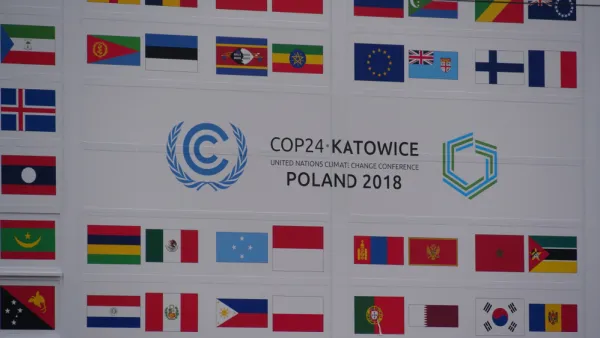
Implementing the Paris Climate Agreement in Katowice, Poland
Representatives from nearly 200 nations have been attending the U.N. Climate Change Conference in Katowice since Dec. 2 to work on implementing the 2015 Paris climate agreement. Scheduled to end Friday, it will be extended two days due to discord.
Part II: The New Regionalism of the Coronavirus Pandemic
Part I was shutting down the economy on a multi-state basis in the absence of federal leadership. Part II will be opening them up in spite of federal assertiveness.

Planetizen Federal Action Tracker
A weekly monitor of how Trump’s orders and actions are impacting planners and planning in America.

California plans to bury El Niño’s downpour
If the state plays its cards right, it may be able to store a billion acre-feet of El Niño’s water in aquifers.

Desperate measures: Advocates weigh draining Lake Powell to fill Colorado River
Draining the reservoir could reduce evaporation losses by a couple hundred thousand acre-feet.

Mamdani’s pied-à-terre tax survives legal challenge
A panel of judges found that the plaintiffs failed to demonstrate injury as a result of New York City's implementation of the tax.

Eastern Nebraska is running out of electricity
Data centers and electrification are straining eastern Nebraska’s grid, throttling economic development.

Seattle passes record-breaking transit services expansion
Proposition 1 will double the city’s transit tax to add 95,000 more bus trips and preserve 180,000 bus trips annually.

FREE Course: Walkable City 1: Why Walkability?
After describing his path towards focusing on walkability as the essence of good planning, Jeff Speck marches through his five principal reasons for making more walkable places.
Reinventing Malls: Planning Alchemy—Turning Gray Fields Into Gold
The course focuses on the opportunities and imperatives that shape reinvention of mall sites.

City of Rosemead
Rutgers University, Edward J. Bloustein School of Planning and Public Policy
One Hundred Miles
University of Michigan School for Environment and Sustainability (SEAS)
Hunter College, City University of New York (CUNY)
The Architects Foundation
City of Cambridge
Montrose County
The Pocatello Development Authority