President Trump will take his first trip abroad on Friday to Saudi Arabia, where he hopes to secure a $40 billion investment for his $1 trillion infrastructure plan. At home, Trump's plan was rebuffed by Texas legislators.


A report from Bloomberg News indicates that the Saudi kingdom's sovereign wealth fund, which is expected to grow to $2 trillion, "is set to announce plans to deploy as much as $40 billion into U.S. infrastructure, according to people familiar with the matter."
Keith Laing, formerly the transportation reporter for The Hill, reports for The Detroit News that taxpayers will fund $200 billion of Trump's infrastructure plan. According to Transportation Secretary Elaine Chao, the public funds would "be used to leverage $1 trillion in infrastructure investment over the next 10 years."
The remainder of the money would come from private companies that would enter into partnerships with local and state governments to provide financing that is necessary to complete expensive construction projects in exchange for revenue that would be generated by things such as road tolls or rail fares.
That public-private vision for infrastructure investment is not sitting well in Texas. "Wary of public opposition to new highway tolls, the Texas House voted on May 5 to reject a bill that would have allowed the partnerships, known as P3s, to participate in 18 highway projects costing as much as $30 billion," reports Mark Niquette for Bloomberg Politics.
The defeat leaves the second most-populous U.S. state unable to tap into the partnerships to finance the infrastructure improvements, even as Trump is proposing to expand their use.
Texas would not be the only state not being to take advantage of a Trump infrastructure plan contingent upon P3 deals. "Nationwide, 13 states have yet to adopt legislation authorizing some form of public-private partnership deals, according to Moody’s Investors Service," adds Niquette.
Hat tip to AASHTO Daily Transportation Update.
Read the full story: Saudis to boost US ties with $40bn investment: Report
50-Cent Gas Tax Increase Ruled-Out by GOP Congressional Leaders
News of the GOP's rejection of a gas tax increase comes from reports on two recent private meetings between Republican leaders and the Trump Administration.
What's Behind the Removal of Public-Private Partnerships from Trump's Infrastructure Plan?
Partnering with the private sector carries risks. Witness the mess that followed the selection of a private firm to build an interstate in Indiana in 2014 that Vice President Mike Pence should have prevented in his prior position as governor.
Transportation Secretary's Resignation Announcement Greeted With Derision
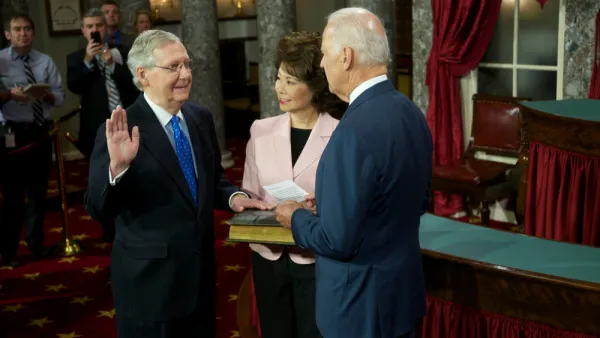
Transportation Secretary Elaine Chao became the first cabinet secretary to announce her resignation due to the storming of the Capitol by Trump supporters, but at least one high-profile member of congress has derided the announcement.

Planetizen Federal Action Tracker
A weekly monitor of how Trump’s orders and actions are impacting planners and planning in America.

Eastern Nebraska is running out of electricity
Data centers and electrification are straining eastern Nebraska’s grid, throttling economic development.

Study reveals best places in the U.S. for cycling, walking
New research from Streetlight Data examines bicycle and pedestrian miles per capita in the 100 largest U.S. cities by population.

Officials look to alter BART extension as price goes through the roof
Tariffs and the war with Iran are behind the rising cost.

To power data centers, Utah company may build hundreds of nuclear reactors on state land
In its permit application, Valar asked for the county to confirm that changes within its outlined plan would still be covered by the permit.

San Antonio is using environmental review to stall ICE detention center
San Antonio sued last month to pause work on the new detention center until the federal government studied its effect on the surrounding area.

FREE Course: Walkable City 1: Why Walkability?
After describing his path towards focusing on walkability as the essence of good planning, Jeff Speck marches through his five principal reasons for making more walkable places.
Reinventing Malls: Planning Alchemy—Turning Gray Fields Into Gold
The course focuses on the opportunities and imperatives that shape reinvention of mall sites.

City of Charlotte
City of Rosemead
Rutgers University, Edward J. Bloustein School of Planning and Public Policy
University of Michigan School for Environment and Sustainability (SEAS)
Hunter College, City University of New York (CUNY)
The Architects Foundation
City of Cambridge
The Pocatello Development Authority
The Urban Renewal Agency of the City of Pocatello