Zak Accuardi argues that while mobility services can enhance transit, only walkability can solve the "first and last mile" problem.


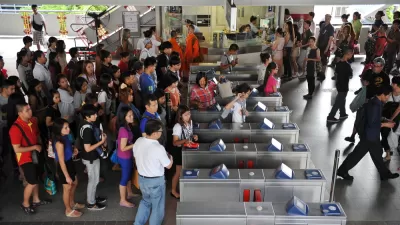
TransitCenter analyst Zak Accuardi speaks to the difficulties of getting riders to widely-dispersed transit stops. "Transit's first and last miles generally happen outside of transit agencies' traditional sphere of concern — operating buses or trains — and thus demand sustained coordination with other governmental actors, especially at the municipal level."
Accuardi maintains that mobility services like rideshare can alleviate the problem, but only so much. He suggests that planners prioritize pedestrian access. "Improving street network connections that make walking to transit easier is among the most useful and cost-effective first and last mile strategies."
"Removing barriers to walking and TOD are likely to yield better ridership and financial return on investment than others designed to draw transit riders from suburban environments—the transportation equivalent of swimming upstream." But in cities designed around the suburban model, that's easier said than done.
Read the full story: Transit is Made for Walking
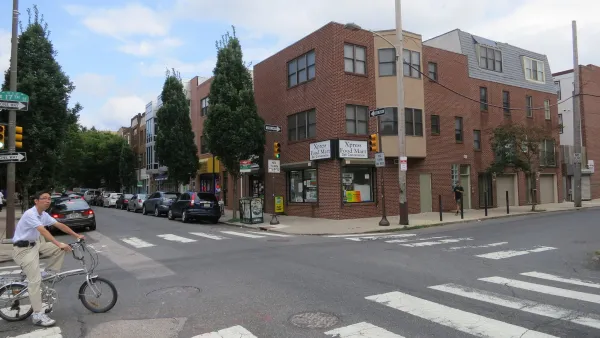
AIA: Demand for High-Density Development Is Down
For the first time in four years, a quarterly survey indicates “market saturation in urban areas.”
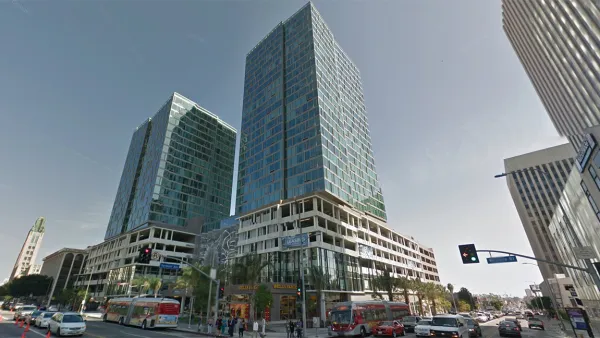
Op-Ed: Build a Dense Wilshire Corridor to Ease L.A.'s Housing Woes
Thom Mayne proposes a radical solution to Los Angeles' affordability/preservation problem: build up transit-friendly areas far beyond current densities, and leave the rest unchanged.
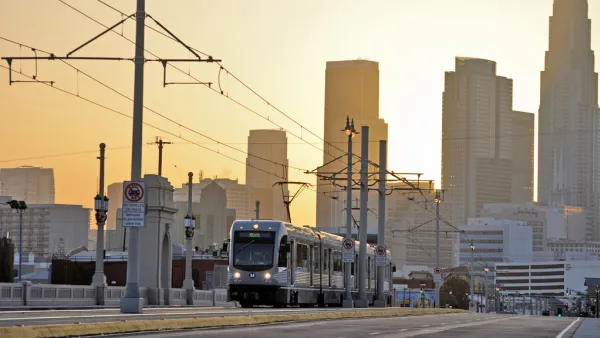
What Will the 'Third Los Angeles' Look Like?
Architecture critic Christopher Hawthorne describes an L.A. in flux, at once beholden to its postwar image and pushing in a new direction. The city, he says, faces existential questions on a scale unmatched elsewhere in the nation.

Planetizen Federal Action Tracker
A weekly monitor of how Trump’s orders and actions are impacting planners and planning in America.

California plans to bury El Niño’s downpour
If the state plays its cards right, it may be able to store a billion acre-feet of El Niño’s water in aquifers.

Desperate measures: Advocates weigh draining Lake Powell to fill Colorado River
Draining the reservoir could reduce evaporation losses by a couple hundred thousand acre-feet.

Mamdani’s pied-à-terre tax survives legal challenge
A panel of judges found that the plaintiffs failed to demonstrate injury as a result of New York City's implementation of the tax.

Eastern Nebraska is running out of electricity
Data centers and electrification are straining eastern Nebraska’s grid, throttling economic development.

Seattle passes record-breaking transit services expansion
Proposition 1 will double the city’s transit tax to add 95,000 more bus trips and preserve 180,000 bus trips annually.

FREE Course: Walkable City 1: Why Walkability?
After describing his path towards focusing on walkability as the essence of good planning, Jeff Speck marches through his five principal reasons for making more walkable places.
Reinventing Malls: Planning Alchemy—Turning Gray Fields Into Gold
The course focuses on the opportunities and imperatives that shape reinvention of mall sites.

City of Rosemead
Rutgers University, Edward J. Bloustein School of Planning and Public Policy
One Hundred Miles
University of Michigan School for Environment and Sustainability (SEAS)
Hunter College, City University of New York (CUNY)
The Architects Foundation
City of Cambridge
Montrose County
The Pocatello Development Authority