The Bertha tunnel boring machine was once stuck under the city of Seattle for more than a year. Now it has reached its goal, four years after it began its journey.


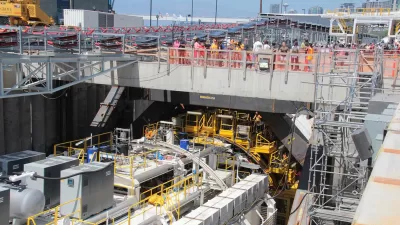
"Nearly four years and 9,270 feet later, the SR 99 tunneling machine nicknamed 'Bertha' emerged from under the Alaskan Way Viaduct near the Seattle Center shortly before 11:30 a.m. on Tuesday," reports Hayat Norimine.
Norimine's focus is more on the humor in the situation, which is how people in Seattle have been coping with Bertha for some time now.
Bertha’s reappearance—after two years of delays, a lawsuit between the state and its contractors Seattle Tunnel Partners over machine damage, and millions of dollars in costs—was broadcast through a WSDOT Live Stream, and very quickly the hashtag #BerthaBreakthrough became a source of inspiration for Seattleites ready to respond with GIFs.
On other local sites, Tom Fucoloro writes that despite the Seattle Bike Blog's long opposition to the project, the project's crews deserve a victory lap for completing the job this week.
David Kroman also writes of the litigious past of the company behind the design-build project, Seattle Tunnel Partners, and the litigious future likely in store for all those involved with the project.
Mike Londblom's coverage of the breakthrough for the Seattle Times also has an eye on the future, describing this week's celebration as "halftime" for the project.
Also be sure to check out Planetizen's ongoing coverage of Bertha's journey.
Read the full story: Bertha’s Journey Inspires Breakthrough GIFs

Bertha on the Move Again in Seattle
Finally, a breakthrough we've all been waiting for: Bertha is on the move again in Seattle and will soon be ready for repairs. The tunnel Bertha was built to drill will have to wait, however.
How Seattle's 'Rose-tinted Fantasy' Threw Billions in Public Money Away
"Seattle is in the midst of a full-spectrum transportation fustercluck," writes David Roberts for Grist.
Forget Sunk Cost—What's the Best Way to Spend Bertha's Remaining Funds?
Seattle’s massive highway tunneling project delays while solutions are sought for the mechanical error that brought the project’s massive drilling machine, Bertha, to a halt. Some are starting to examine life after Bertha.

Planetizen Federal Action Tracker
A weekly monitor of how Trump’s orders and actions are impacting planners and planning in America.

Amtrak, CN end decades-long dispute with eight-year agreement
The new operating agreement establishes an updated framework for the companies to work together, including processes to resolve disputes.

Judges permit Denver to divert 77,000 acre feet from the Colorado River for reservoir expansion
Overuse and climate change have caused the Colorado River’s water levels to plummet.

NYC DOT wants faster, more permanent street upgrades
The city is examining ways to build more concrete infrastructure without getting entangled in 'decades-long' projects.

'Something we’ve never seen before:' rising utility rates could strain city finances nationwide
Data centers, climate change and other factors have caused utility rates in the United States to increase by 38% since 2020.

Trump to overrule local leaders, lease millions of acres of America’s Pacific Island territories’ seafloors to mining companies
International law says that the Indigenous people of America’s territories have a right to prior and informed consent regarding projects that impact their countries.

FREE Course: Walkable City 1: Why Walkability?
After describing his path towards focusing on walkability as the essence of good planning, Jeff Speck marches through his five principal reasons for making more walkable places.
Reinventing Malls: Planning Alchemy—Turning Gray Fields Into Gold
The course focuses on the opportunities and imperatives that shape reinvention of mall sites.

Harvard University Graduate School of Design
KFH Group Inc.
Greater Baltimore Committee
The Architects Foundation
University of Cincinnati Online
The Pocatello Development Authority
The Urban Renewal Agency of the City of Pocatello