Seattle’s massive highway tunneling project delays while solutions are sought for the mechanical error that brought the project’s massive drilling machine, Bertha, to a halt. Some are starting to examine life after Bertha.


Ben Schiendelman sees solutions for the Bertha mess, and they don't involve fixing Bertha. In fact, the writer never agreed that the Washington State Department of Transportation's tunnel project was the best way to meet the capacity currently carried by the Alaskan Way Viaduct: "That’s just how cost-ineffective this tunnel really is – most of this capacity can be met with an order of magnitude less money. Sure, the trips in cars aren’t as fast, but the trips on transit are much faster..."
If the state pulled the plug on the tunnel project, there would be about $800 million leftover from the project. For $150 million, Schiendelman claims the state could accomplish three things that would meet the required 60,000 car-trip capacity of the viaduct: 1) Reconnecting the street grid in South Lake Union, 2) the Center City Connector, and 3) RapidRide bus priority projects. Schiendelman gets the 60,000 number from data recently released by the Seattle Department of Transportation.
Read the full story: What Could $800 Million Do?

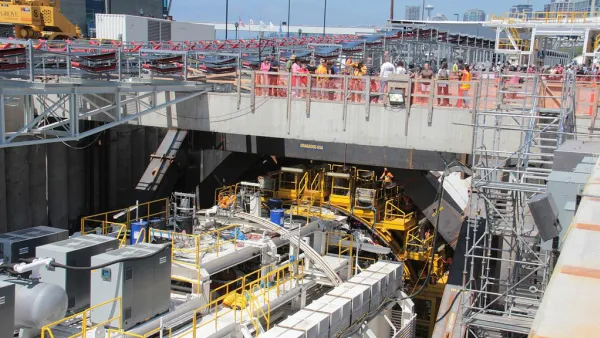
Bertha Finally Breaks On Through (To the Other Side)
The Bertha tunnel boring machine was once stuck under the city of Seattle for more than a year. Now it has reached its goal, four years after it began its journey.
Bertha on the Move Again in Seattle
Finally, a breakthrough we've all been waiting for: Bertha is on the move again in Seattle and will soon be ready for repairs. The tunnel Bertha was built to drill will have to wait, however.
How Seattle's 'Rose-tinted Fantasy' Threw Billions in Public Money Away
"Seattle is in the midst of a full-spectrum transportation fustercluck," writes David Roberts for Grist.

Planetizen Federal Action Tracker
A weekly monitor of how Trump’s orders and actions are impacting planners and planning in America.

Amtrak, CN end decades-long dispute with eight-year agreement
The new operating agreement establishes an updated framework for the companies to work together, including processes to resolve disputes.

Judges permit Denver to divert 77,000 acre feet from the Colorado River for reservoir expansion
Overuse and climate change have caused the Colorado River’s water levels to plummet.

Alabama scores up to $2.5 billion federal loan for largest infrastructure project in state’s history
The Mobile River Bridge and Bayway Project aims to ease congestion at Alabama’s worst bottleneck.

Trump is considering data centers on 6 states' public land — some state officials say they had no idea
If the administration approves the proposed projects, data center and data center-related developments will cover 17,600 acres of public land.

Despite court ruling, Trump is keeping nearly all wind projects in the US on hold
At least 110 wind energy projects have not heard from the government since a federal judge ruled that the Trump administration's freeze on wind turbine clearances was likely illegal.

FREE Course: Walkable City 1: Why Walkability?
After describing his path towards focusing on walkability as the essence of good planning, Jeff Speck marches through his five principal reasons for making more walkable places.
Reinventing Malls: Planning Alchemy—Turning Gray Fields Into Gold
The course focuses on the opportunities and imperatives that shape reinvention of mall sites.

KFH Group Inc.
Greater Baltimore Committee
Eagle County Government
The Architects Foundation
University of Cincinnati Online
The Pocatello Development Authority
The Urban Renewal Agency of the City of Pocatello