Two widely cited University of Michigan transportation researchers urge consumers to drive more fuel efficient vehicles to reduce their own carbon emissions as President Trump works to relax vehicle fuel economy standards.


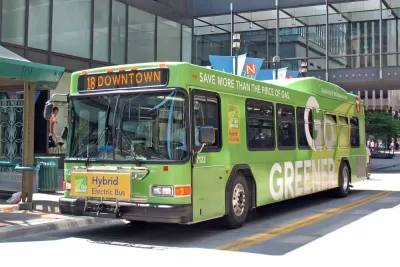
As President Trump turns back the clock on mitigating greenhouse gas emissions, individual actions to reduce one's own carbon footprint become ever more important. According to a paper (pdf) written by University of Michigan Transportation Research Institute researchers Michael Sivak and Brandon Schoettle in support of the 2015 Paris Climate Agreement, the most effective action a person concerned about climate change can do is to drive a fuel-efficient vehicle.
Sivak and Schoettle, who monitor the fuel economy of new vehicles purchased (as opposed to manufactured) on a monthly basis, have found that after gas prices began falling in July 2014, the average miles per gallon flatlined after having risen from 21 miles per gallon for model year 2008 to 25 mpg for model year 2014. [See graph].
"The main reason was the drop in the price of gasoline to $2.14 in 2016 from $3.36 a gallon in 2014" write Sivak and Schoettle in a New York Times Sunday Review opinion. Average gas prices on March 29 were $2.29.
Now, fueling a less fuel-efficient but more spacious vehicle like an S.U.V. or pickup truck costs no more than fueling a small sedan did a few years ago. And buyers have responded by buying more of those bigger, less fuel-efficient vehicles.
And the auto sales figures reflect that preference larger vehicles. Last year, light trucks, a category of passenger vehicles that include popular sport utility and crossover vehicles, outsold more fuel-efficient cars, accounting for a record 61 percent of auto sales. In fact, those sales figures were indirectly referenced by Environmental Protection Agency Scott Pruitt as justification for reducing vehicle emissions standards.
"We ought to focus on fuel efficiency for cars that people really want to buy," Pruitt stated on a Sunday news show on March 26 (posted here).
On March 15, President Trump announced that he had ordered the U.S. Environmental Protection Agency and the Department of Transportation to reopen the review of fuel efficiency standards for model year 2022-2025 passenger vehicles in order to ease the Obama-era ruling.
Notwithstanding Trump's executive order on Tuesday to dismantle the Clean Power Plan, emissions from U.S. power plants continue to decrease while those from transportation are on the rise, according to research (pdf) by Sivak and Schoettle posted here last July.
Read the full story: What You Can Do About Climate Change

Are EPA's Fuel Efficiency Standards the Next Environmental Rollback?
Next on President Trump's environmental chopping block may be a rollback of fuel efficiency standards. Two auto associations have asked EPA Administer Scott Pruitt to review a decision made last month to retain a 54.5 mpg target.
2016: Year of the Sports Utility Vehicle
Last year set two notable vehicle records. First, the most cars ever sold, at 17.54 million. Second, light trucks accounted for almost 61 percent of all sales. Sales of more fuel efficient car fell, though electric vehicle sales increased.
Hybrid and Electric Cars Take a Downturn in the Used Car Market
It's not just Americans favor SUVs and light truck over compact cars, but that a majority of EV and hybrid owners who have traded in their cars are opting for all-gas vehicles, and that spells trouble for meeting President Obama's climate goals.

Planetizen Federal Action Tracker
A weekly monitor of how Trump’s orders and actions are impacting planners and planning in America.

Amtrak, CN end decades-long dispute with eight-year agreement
The new operating agreement establishes an updated framework for the companies to work together, including processes to resolve disputes.

Northwest rail fans eager for Sept. 30 debut of Amtrak’s Airo fleet
Get ready for that new train smell and more seats. But they won’t go faster or run more frequently on the Cascades route in Washington and Oregon.

LAX SkyLink opening delayed again, contractor won’t commit to new deadline
The project was supposed to open its doors to the public in 2023.

Caltrain may slash over one-third of its stations
If Bay Area voters reject two transit tax measures, Caltrain, BART and AC Transit will see steep service cuts.

A 'dangerous' precedent: North Carolina successfully pressures communities into voting for toll roads
Two mayors resigned from the Charlotte Regional Transportation Planning Organization after it voted in favor of the toll roads.

FREE Course: Walkable City 1: Why Walkability?
After describing his path towards focusing on walkability as the essence of good planning, Jeff Speck marches through his five principal reasons for making more walkable places.
Reinventing Malls: Planning Alchemy—Turning Gray Fields Into Gold
The course focuses on the opportunities and imperatives that shape reinvention of mall sites.

City of Thousand Oaks
City of Wisconsin Rapids
Harvard University Graduate School of Design
The Architects Foundation
University of Cincinnati Online
The Pocatello Development Authority
The Urban Renewal Agency of the City of Pocatello