An article and video by Chicago PBS station WTTW explore San Francisco's uniquely ambitious approach to sharing the city with wildlife.



Sean Keenehan reports on San Francisco's Green Connections Plan: "an ambitious 115-mile, 24-route map of potential habitat corridors in San Francisco."
The Green Connections Plan began in 2011, led by the non-profit organization Nature in the City in collaboration with city and community-based agencies. The big idea expands on what we traditionally think about transportation planning by "imagining a world in which cars share the road with birds, bees, butterflies, and bicyclists," explains Keenehan.
"Each route in the network is named after a native San Francisco 'Key Species' and is designed to incorporate 'Key Habitat' for that species," according to Keenehan.
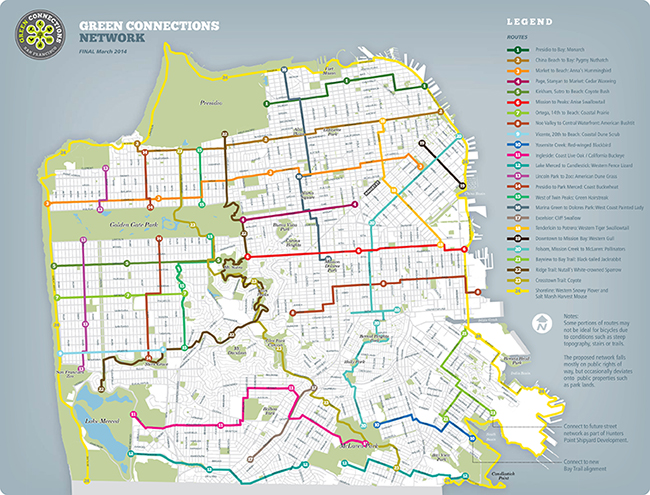
To get a feel for the plan's Green Connections, Keenehan takes a bike ride along with Green Connections director Amber Hasselbring in a video you can watch after the jump.
Local coverage of a recent Green Connections walk is also available on the San Francisco Examiner website.
Read the full story: A Wild Plan for San Francisco

A New Plan for Sea Level Rise in the San Francisco Bay Area
The San Francisco Bay has 400 miles of shoreline, and a dire need for a new approach to dealing with the effects of rising water levels. An estimated $100 billion in potential property damage is at risk.
Adapting Combined Sewer-Stormwater Systems to Climate Change
Only one coastal city has a sewer system that must handle stormwater as well as wastewater. San Francisco's efforts to adapt its combined sewer-stormwater system has put it on the vanguard of the city's climate adaptation efforts.
8 Ways to Sustainably Manage Stormwater
From permeable paving to green roofs, a number of cost-effective and sustainable strategies have emerged for managing water closer to where it falls, rather than directing it into pipes. SPUR explains 8 promising tools for managing stormwater.

Planetizen Federal Action Tracker
A weekly monitor of how Trump’s orders and actions are impacting planners and planning in America.

The state-sanctioned urbicide of Austin
People don’t kill cities. Freeways do.

US to reduce Colorado River water deliveries to Mexico
A new Colorado Treaty amendment reduces Mexico’s Colorado River water allocation by 250,000 acre feet.

Nation's most wind-powered state turns to coal as data centers increase energy demand
For the first time in decades, Iowa has increased its generation of coal power.

NYC cools commuters with city's first rain garden above a bus stop
New York City officials say the plants in the rain garden can absorb 16 gallons of rainwater during heavy storms.

Brightline West’s future may rely on $6 billion federal loan
The company has until Nov. 2 to make a $400 million equity investment into its proposed high-speed rail line.

FREE Course: Walkable City 1: Why Walkability?
After describing his path towards focusing on walkability as the essence of good planning, Jeff Speck marches through his five principal reasons for making more walkable places.
Reinventing Malls: Planning Alchemy—Turning Gray Fields Into Gold
The course focuses on the opportunities and imperatives that shape reinvention of mall sites.

Eagle County Government
Harvard University Graduate School of Design
Nashville Planning Department
The Architects Foundation
University of Cincinnati Online
The Pocatello Development Authority
The Urban Renewal Agency of the City of Pocatello
Journal of the American Planning Association