Two new express lanes in each direction of the 91 Freeway in Corona dubbed the Corona Crawl opened for traffic on March 20. The lanes connect to the 91 Express Lanes in Orange County, providing 18 miles for carpoolers or those willing to pay a toll.


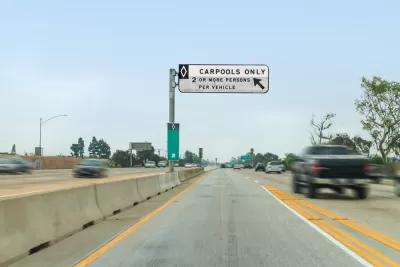
The 91 Express Lanes, the nation's oldest High Occupancy Toll (HOT) lanes, also considered a toll road as they were built in the median of State Route (SR)-91 in Orange County by the California Private Transportation Company with no public funds, opening in 1995, are now the newest as well, thanks to the opening of an 8-mile stretch in Riverside County.
A major difference from the one-year-old I-580 Express Lanes in the Bay Area regard those in carpools. As the above video shows, three-person or more carpoolers need to drive in the designated lane to get the discount. Yes, a half-price toll is applied in the eastbound direction from 4-6 p.m. while they drive free at other times.
In the Bay Area, where express lanes are still considered somewhat new, two people compose a carpool, and travel is always free, though on the I-580 lanes, a newer type of Fastrak transponder is needed otherwise the licence plate is photographed, and a toll is charged. The 91 Express Lanes don't allow for license plate tolling.
So what do you get for $1.4 billion? A widened freeway plus many other capacity-increasing improvements, according to the project website:
[T]he [Riverside County Transportation Commission] 91 Corridor Improvement Project added regular lanes, tolled express lanes, auxiliary lanes and direct express lane connectors from the northbound I-15 to the westbound SR-91 and from the eastbound SR-91 to the southbound I-15. Improvements to interchanges, ramps and surface streets were also made along the 91 corridor.
"With nearly 300,000 people who travel the stretch each day, it's not going to make traffic disappear, but the hope is that it's alleviated," reports Christina Salvo for ABC7 Eyewitness News.
Hat tip to Bernie Wagenblast of AASHTO Daily Transportation Update.
Read the full story: New, long-awaited express toll lanes open up on 91 Freeway in Corona
Converting a Carpool Lane to a High Occupancy Toll Lane No Easy Task
Supervisors of California's fourth-largest county declared their formal opposition to the conversion of carpool lanes on the Riverside Freeway to high occupancy toll (HOT) lanes, but they are open to toll lanes, under the right conditions.
More Toll Lanes Coming to California Freeways
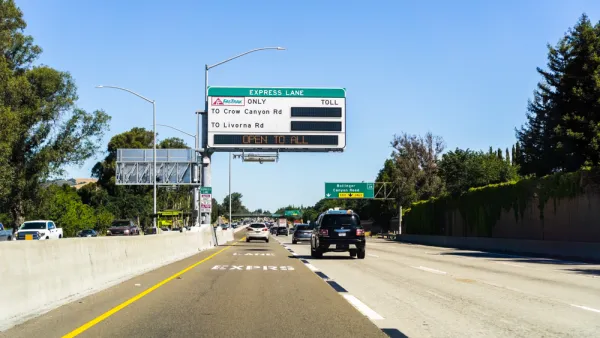
Solo drivers in the Golden State will have more options to escape traffic congestion on busy freeways – for a price, as transportation agencies increasing decide to convert existing carpool lanes to high-occupancy toll lanes and add new ones.
Popularity of Express Lanes Spreads Beyond Virginia
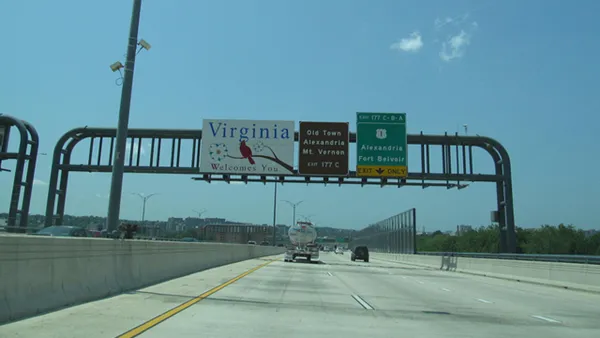
Dan Vock of Governing takes a broad look at congestion pricing, beginning with the success of Virginia's 66 Express Lanes, the ones where tolls initially topped $40. Notwithstanding complaints, managed lanes are spreading, but challenges remain.

Planetizen Federal Action Tracker
A weekly monitor of how Trump’s orders and actions are impacting planners and planning in America.

Eastern Nebraska is running out of electricity
Data centers and electrification are straining eastern Nebraska’s grid, throttling economic development.

Study reveals best places in the U.S. for cycling, walking
New research from Streetlight Data examines bicycle and pedestrian miles per capita in the 100 largest U.S. cities by population.

Next-generation nuclear reactors are coming to Texas
The reactors will not require towering containment structures thanks to new safety features.

California distributes $1.3 billion to prevent transit service cuts, bolster projects
Twenty-eight projects across California received a portion of the funding.

Pennsylvania Democrats have 15 affordability, clean energy bills for flipped state Senate
Bills in consideration include a bill supporting geothermal energy and a bill supporting solar on warehouses.

FREE Course: Walkable City 1: Why Walkability?
After describing his path towards focusing on walkability as the essence of good planning, Jeff Speck marches through his five principal reasons for making more walkable places.
Reinventing Malls: Planning Alchemy—Turning Gray Fields Into Gold
The course focuses on the opportunities and imperatives that shape reinvention of mall sites.

City of Charlotte
City of Rosemead
Rutgers University, Edward J. Bloustein School of Planning and Public Policy
University of Michigan School for Environment and Sustainability (SEAS)
Hunter College, City University of New York (CUNY)
The Architects Foundation
City of Cambridge
The Pocatello Development Authority
The Urban Renewal Agency of the City of Pocatello