In advance of unveiling his infrastructure plan on Tuesday night, President Trump pointed to the hazards posed by "missing tiles" in two New York City tunnels and wondered aloud how many had fallen on motorists. Answer: none.


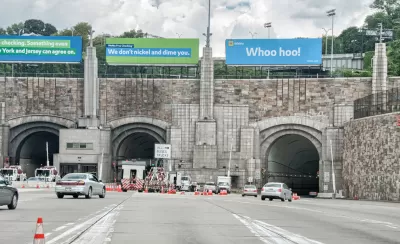
President Trump is known to veer off script, which can be troublesome even if it often goes over well with his supporters. In his remarks to the National Governors Association's winter meeting in the White House on Monday, he told them to expect something 'big' from him on infrastructure during his address to a joint session of Congress on Tuesday.
As an example, he cited two tunnels that serve Manhattan that appear, to him, to not only be in a state of disrepair, but to pose serious safety hazards.
Our tunnels -- I mean, we have tunnels in New York where the tiles are on the ceiling, and you see many tiles missing. And you wonder, you know, you're driving at 40 miles an hour, 50 miles an hour through a tunnel.
Take a look at the Lincoln Tunnel and the Queens Midtown Tunnel,, and you're driving, and you see all this loose material that's heavy....And I say to myself -- every time I drive through, I say, I wonder how many people are hurt or injured when they are driving at 40, 50 miles an hour through a tunnel, and the tile falls off.
Trump can't be blamed for thinking of falling tiles—it's not unreasonable. The CBS News show, 60 Minutes, did a memorable infrastructure report in November 2014 that pointed to Pittsburgh's decaying Greenfield Bridge. The temporary solution to deal with falling debris was to place a bridge under the bridge just to protect traffic below from being hit by falling debris. But why not have his staff research the tunnels' 'falling tiles' before citing them?
Vincent Barone and Emily Ngo, reporters for amNewYork, investigated. First, the Queens Midtown Tunnel:
Not a single person has been injured by any falling tiles because no tiles are falling — they are being replaced by workers as part of an infrastructure project to repair the tunnel from Hurricane Sandy damage,” said Beth DeFalco, an MTA [Metropolitan Transportation Authority] spokeswoman, in an email.
As for the Lincoln Tunnel, the result was the same:
A spokesman for the Port Authority, which operates the Lincoln Tunnel, said in a statement that “the tile structures in the various Lincoln Tunnel tubes are intact, regularly inspected and pose no danger to the public. In the last 12 months there have been no reported incidents involving falling tiles.
There is no need to point to false examples of infrastructure disrepair when thousands of American bridges are either structurally deficient and/or functionally obsolete.
Eugene Mulero reports for Transport Topics that the governors' association responded to Trump's comments on infrastructure, specifically, how to finance the infrastructure investment.
“Public-private partnerships are a great tool, and I think they have to be embraced,” Gov. John Hickenlooper (D-Colo.) said at the association’s closing press conference. “There’s got to be additional revenues, and states will have to come up with additional resources. The federal government will have to come up with additional resources.”
Hat tips to Brianna Gurciullo, POLITICO Morning Transportation, and MTC-ABAG Library.
FULL STORY: Trump fears tiles fall from NYC tunnels, pledges ‘big’ infrastructure spending

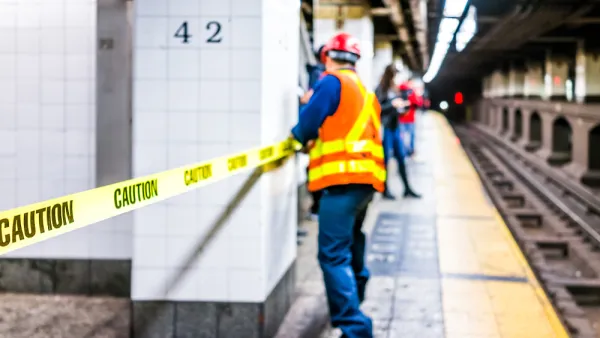
Why New York City's Flooding Its Own Subway Entrances
MTA reassured disoriented New Yorkers that it's flooding subway entrances on purpose, to test barriers that it hopes will guard the system against another Sandy.
50-Cent Gas Tax Increase Ruled-Out by GOP Congressional Leaders
News of the GOP's rejection of a gas tax increase comes from reports on two recent private meetings between Republican leaders and the Trump Administration.
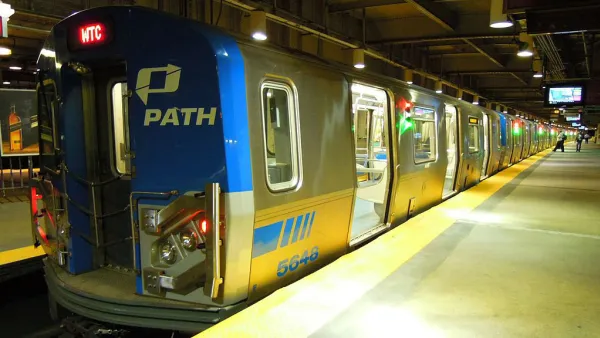
Financing of Hudson River Rail Tunnels in Peril
A funding agreement between New York, New Jersey, and the U.S. DOT for one of the most important rail projects in the nation is in danger of collapsing because of the way the two states are financing their share of the $12.9 billion cost.

The state-sanctioned urbicide of Austin
People don’t kill cities. Freeways do.

US to reduce Colorado River water deliveries to Mexico
A new Colorado Treaty amendment reduces Mexico’s Colorado River water allocation by 250,000 acre feet.

New Jersey’s second-largest city bans standalone data centers
Jersey City will continue to allow co-location facilities, such as those meant for research institutions that store their own data.

Amtrak not solely to blame for New Jersey commuter rail's unreliability, report finds
A new study from the Garden State Initiative found that NJ Transit’s budget grew 20% across a 4 year period, but reliability declined significantly over the same period.

EPA erases limits on planet-warming pollution from power plants
Under Monday’s plan, power plants would still have some limits on how much mercury, arsenic and other contaminants they can emit.

Phoenix announces new on-demand transit service, more frequent RAPID buses
Both new services will launch in October, and are part of Phoenix's Project Effective Access Solutions for Easing Congestion.

FREE Course: Walkable City 1: Why Walkability?
After describing his path towards focusing on walkability as the essence of good planning, Jeff Speck marches through his five principal reasons for making more walkable places.
Reinventing Malls: Planning Alchemy—Turning Gray Fields Into Gold
The course focuses on the opportunities and imperatives that shape reinvention of mall sites.

Eagle County Government
Harvard University Graduate School of Design
Nashville Planning Department
The Architects Foundation
University of Cincinnati Online
The Pocatello Development Authority
The Urban Renewal Agency of the City of Pocatello
Journal of the American Planning Association