The U.S. Senate confirmed Scott Pruitt on Friday afternoon as administrator of the EPA, the same agency he sued 14 times in his capacity as Oklahoma Attorney General. He could not be more different than his predecessor, Gina McCarthy.


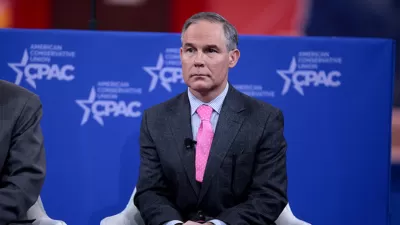
The selection of the now former Oklahoma Attorney General to head the EPA would, at first glance, seem be in conflict with the purpose of the America's premier agency—to protect the environment.
"Mr. Pruitt, who has expressed skepticism about human-caused global warming, has been a key architect of the legal battle to overturn the rules," reports Coral Davenport for The New York Times. However, that position is consistent with that of his boss, President Donald Trump, who infamously called climate change a 'Chinese hoax' in 2012.
The Senate vote, taken Friday afternoon after Democrats held the Senate floor since Thursday, hoping to delay the vote until court-ordered letters were released (see below) was largely along party lines, with a few notable exceptions.:
Senators voted 52 to 46 to confirm Mr. Pruitt, the Oklahoma attorney general who has built a career out of suing to block the E.P.A.’s major environmental rules and has called for the dissolution of much of the agency’s authority. One Republican, Susan Collins of Maine, crossed party lines to vote against Mr. Pruitt, while two Democrats, Joe Manchin III of West Virginia and Heidi Heitkamp of North Dakota, both from coal-rich states where voters generally oppose environmental rules, voted for him.
Not voting: Sen. Joe Donelly (D-Ind.) and Sen. John McCain (R-Ariz.). See U.S. Senate Roll Call Votes.
Both opponents and supporters of Mr. Pruitt’s say he is well positioned to carry out Mr. Trump’s campaign trail promises to dismantle the agency and slash its ranks of employees. Mr. Trump vowed to "get rid" of the agency "in almost every form."
How much influence will fossil fuel companies have in the EPA?
If we are to learn from how Pruitt regulated energy companies in the Sooner State, expect those companies to play an outsized role in a Pruitt-administered EPA:
A 2014 investigation by The Times found that energy lobbyists drafted letters for Mr. Pruitt to send, on state stationery, to the E.P.A., outlining the economic hardship of the environmental rules.
Democrats had hoped to delay the confirmation vote until Pruitt "turn(ed) over nearly 3,000 emails related to his communications with the oil and gas sector" per a court order, reported for The Washington Times. "The nominee has until Tuesday to turn over those documents, which Democrats argue will show that Mr. Pruitt is in the pocket of the fossil fuel industry and is unfit to lead the EPA."
The vote outcome was welcomed by Republicans as a way to reign in the reach of the EPA for the last eight years under former administrator Gina McCarthy, appointed by President Obama in 2013.
"[A]s someone with state government experience, [Pruitt] understands the real-world consequences of E.P.A. actions and knows that balance is the key to making policies that are sustainable over the long-term”, stated Senate Majority Leader Mitch McConnell.
The PBS NewsHour on Friday night presented two contrasting perspectives on what the confirmation means for environmental policy and regulation with guests Myron Ebell, director of the Center for Energy and Environment at the Competitive Enterprise Institute Environment and Jeremy Symons, Associate Vice President of Climate Political Affairs for the Environmental Defense Fund.
Here's a compilation of Pruitt's 14 challenges to EPA rules, including a ruling last June by the Supreme Court that denied the appeal of 20 states on a rule regulating mercury emissions largely from coal powered plants.
FULL STORY: Senate Confirms Scott Pruitt as E.P.A. Head

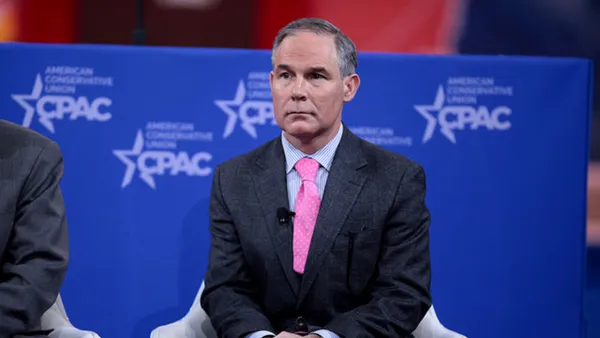
EPA Chief Scott Pruitt Resigns
Climate change denier Scott Pruitt, head of the U.S. Environmental Protection Agency, submitted his resignation on Thursday, to take effect July 6. On Monday, EPA Deputy Administrator Andrew R. Wheeler becomes the acting administrator.
Trump Administration Releases Climate Report that Contradicts EPA Chief
In a move that surprised some, the Fourth National Climate Assessment found that climate change is "unambiguous" as opposed to a "hoax," as President Trump has stated, and that it is man-made, largely caused by the burning of fossil fuels.

Congress Fails to Roll Back Obama-Era Methane Emissions Rule
Current events that have nothing to do with the environment but everything to do with politics might have caused the defeat of a bill to overturn an Obama-era rule designed to reduce methane emissions on federal lands.

Planetizen Federal Action Tracker
A weekly monitor of how Trump’s orders and actions are impacting planners and planning in America.

The state-sanctioned urbicide of Austin
People don’t kill cities. Freeways do.

US to reduce Colorado River water deliveries to Mexico
A new Colorado Treaty amendment reduces Mexico’s Colorado River water allocation by 250,000 acre feet.

5 New England states march closer to 800 megawatt wind energy project
Securing federal approval for the project may be complicated under the Trump administration, which has historically been hostile towards domestic wind power.

Baltimore to break ground on $50 million Transit Priority Project
The project will bring faster bus trips, safer streets and better bike connections to Baltimore.

Airbnb launches $250 million 'last-dollar financing' housing accelerator, makes first investment in Austin
The company will put $6.4 million towards affordable housing development in Texas’ capital.

FREE Course: Walkable City 1: Why Walkability?
After describing his path towards focusing on walkability as the essence of good planning, Jeff Speck marches through his five principal reasons for making more walkable places.
Reinventing Malls: Planning Alchemy—Turning Gray Fields Into Gold
The course focuses on the opportunities and imperatives that shape reinvention of mall sites.

Eagle County Government
Harvard University Graduate School of Design
Nashville Planning Department
The Architects Foundation
University of Cincinnati Online
The Pocatello Development Authority
The Urban Renewal Agency of the City of Pocatello
Journal of the American Planning Association