Uber kicks off its 'Year of the Driver' by suing the city of Seattle for allowing its drivers to unionize.



The Seattle City Council was unanimous in passing its resolution to let drivers that work for transportation network companies unionize. The law "allows drivers for ride-hailing apps like Uber and Lyft to unionize and collectively bargain for better working conditions, earnings, and other benefits. The bill was a victory for the App-Based Drivers Association, which had lobbied with the local Teamsters Union on behalf of freelance contractors," Andrew J. Hawkins reports in The Verge.
Uber, which was recently valued at $66 billion, called the law "arbitrary and capricious." They contend that allowing the company's drivers to unionize is unfair, an argument that will be tested in court at the beginning of 2017, just when Uber had been trying to improve its relationship with its drivers. "The company recently named 2017 'the year of the driver'," Hawkins writes. Evidently, they do not wish to do this by dealing with the driver's nascent union.
Read the full story: Uber sues Seattle over law allowing drivers to unionize

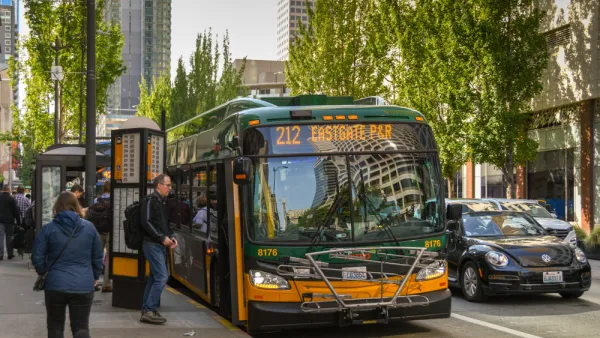
Seattle Transit Winning Back Riders Faster Than Ridehailing
Ridehailing companies saw a steep drop in ridership in the city during the pandemic, followed by a slow recovery as their prices increase and demand slows.
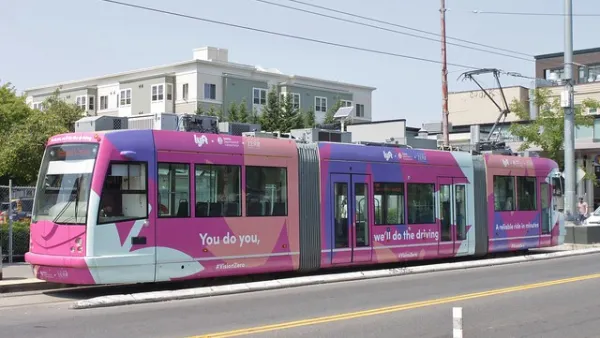
Ride-Hailing Tax to Fund Affordable Housing on the Table in Seattle
Seattle would join cities like New York, Chicago, and Washington, D.C. in taxing rides with companies like Uber and Lyft. Seattle would use some of that revenue to fund affordable housing projects.

Uber and Lyft Reveal Seattle-Area Trip Data
After a court battle, the two big transportation network companies finally released trip data, revealing rapid growth and a concentration of rides in the city's most congested areas.

Planetizen Federal Action Tracker
A weekly monitor of how Trump’s orders and actions are impacting planners and planning in America.

Amtrak, CN end decades-long dispute with eight-year agreement
The new operating agreement establishes an updated framework for the companies to work together, including processes to resolve disputes.

Judges permit Denver to divert 77,000 acre feet from the Colorado River for reservoir expansion
Overuse and climate change have caused the Colorado River’s water levels to plummet.

NYC DOT wants faster, more permanent street upgrades
The city is examining ways to build more concrete infrastructure without getting entangled in 'decades-long' projects.

'Something we’ve never seen before:' rising utility rates could strain city finances nationwide
Data centers, climate change and other factors have caused utility rates in the United States to increase by 38% since 2020.

Trump to overrule local leaders, lease millions of acres of America’s Pacific Island territories’ seafloors to mining companies
International law says that the Indigenous people of America’s territories have a right to prior and informed consent regarding projects that impact their countries.

FREE Course: Walkable City 1: Why Walkability?
After describing his path towards focusing on walkability as the essence of good planning, Jeff Speck marches through his five principal reasons for making more walkable places.
Reinventing Malls: Planning Alchemy—Turning Gray Fields Into Gold
The course focuses on the opportunities and imperatives that shape reinvention of mall sites.

Harvard University Graduate School of Design
KFH Group Inc.
Greater Baltimore Committee
The Architects Foundation
University of Cincinnati Online
The Pocatello Development Authority
The Urban Renewal Agency of the City of Pocatello