California's loss is Arizona's gain. That's how Arizona Gov. Doug Ducey see's Uber's decision on Thursday to haul their fleet of self-driving Volvos from San Francisco to Arizona after the company refused to secure the necessary operating permits.


"Uber is moving its self-driving pilot project to Arizona, one day after the California Department of Motor Vehicles ordered the autonomous vehicles off the roads in San Francisco," reports Trisha Thadani for the San Francisco Chronicle.
A week earlier, the DMV had sent Uber a letter ordering the transportation network company to cease operation of its self-driving cars until it complies with regulations, meaning it had to secure an autonomous vehicle testing permit. The state Attorney General's office chimed in as well.
In the above KTVU news broadcast, former Chronicle columnist Chuck Nevis speculates why Uber chose not to comply with DMV's order to properly register the vehicles, and ponders the effect the move will have on San Francisco and Oakland, where it is based and expanding to, respectively.
"It seems strange, doesn't it, because the city said all you have to do is buy a permit; we'll give it to you in 72 hours, and you are in business," Nevius tells Ted Rowlands of KTVU. "But I think the deeper issue was that Uber didn't want to share the data that would be gathered."
Nevius indicates that there would need to be an incident report for when the driverless car went through the redlight, "and you saw the uproar that caused." Rowlands adds, "Uber went up against the SF Bike Coalition — not a good deal — might as well go up against the mob," referring to the group's political strength.
Uber's Vice President of Engineering, Anthony Levandowski, provided this statement to explain why they refused to secure the permits the DMV required for their autonomous vehicles.
California's loss is Arizona's gain?
A 19-photo slide gallery in the article shows the automated vehicles loaded on a flatbed truck for their journey to Arizona. While the destination city wasn't known, the cars were reported to have been seen in Phoenix.
“Phoenix is excited to be an Uber-friendly city, and we are excited that they are expanding here,” said Robbie Sherwood, a spokesman for the Phoenix mayor’s office.
"In a statement Thursday, Arizona Gov. Doug Ducey called California’s regulations burdensome and said Arizona welcomes Uber’s self-driving car test with 'open arms,'" adds Thadani.
“While California puts the brakes on innovation and change with more bureaucracy and more regulation, Arizona is paving the way for new technology and new businesses,” he said.
No special regulations for autonomous vehicles in Arizona.
Ducey signed an executive order in 2015 that supports the testing and operation of self-driving cars in Arizona. Google began testing its autonomous cars in several cities there this year.
For self-driving vehicles in Arizona, “there are no special permits or licensing required,” according to the state’s Department of Transportation. “In Arizona, autonomous vehicles have the same registration requirements as any other vehicle, and nothing in state law prevents testing autonomous vehicles.”
Academic relationships forged, as Uber did in Pittsburgh.
"Uber said last year that Tucson and the University of Arizona will become “the next home to our Uber mapping test vehicles.”
Uber's relationship with Carnegie Mellon University in Pittsburgh, where Uber first began testing of self-driving vehicles in September, turned out to be stormy. It "partnered with one of the most advanced university robotics labs in the US last year—only to immediately poach a third of its top scientists and its director," writes Jordan Pearson for Motherboard.
Speaking of regulations....
This isn't the first time the Grand Canyon State and the Golden State have found themselves on opposite sides of regulation of an industry. A year after California made history by banning the single-use disposable bag (and voters upheld the ban in a referendum in November, bankrolled by the plastics industry), Gov. Ducey signed a bill that outlawed local governments from banning single-use plastic bags
+++++++++++++++++++
Related on Planetizen:
FULL STORY: Uber sending self-driving cars to Arizona


Failure of Automated Driving Technology Blamed for First Pedestrian Fatality
Experts who watched the videos taken by onboard cameras equipped in the Volvo SUV that hit Elaine Herzberg determined that Uber's automated driving system failed to perform adequately. The crash points to a need for regulations.
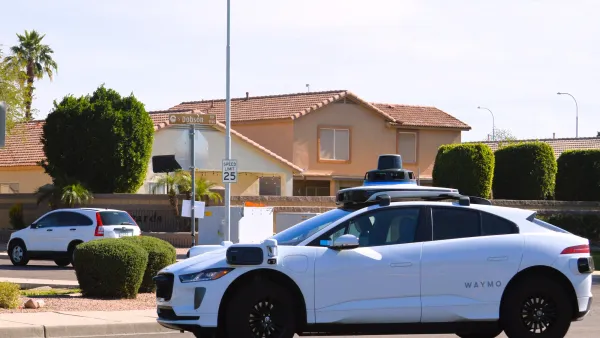
Uber and Waymo part ways in Phoenix
The companies ended a three-year pilot program, with Waymo saying it plans to keep its Phoenix robotaxi fleet available through its own app.
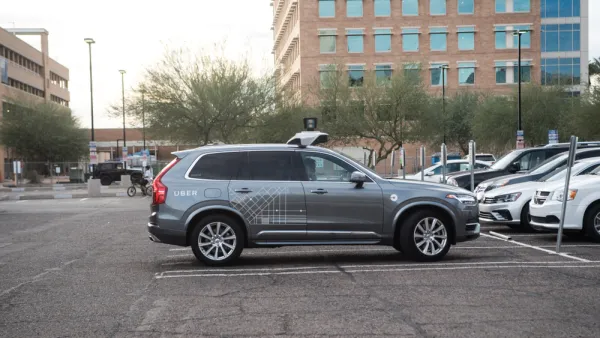
Uber Wants to Return its Autonomous Vehicles to Public Roads
The move comes almost eight months after a self-driving Uber vehicle struck and killed a pedestrian.

Planetizen Federal Action Tracker
A weekly monitor of how Trump’s orders and actions are impacting planners and planning in America.

The state-sanctioned urbicide of Austin
People don’t kill cities. Freeways do.

US to reduce Colorado River water deliveries to Mexico
A new Colorado Treaty amendment reduces Mexico’s Colorado River water allocation by 250,000 acre feet.

5 New England states march closer to 800 megawatt wind energy project
Securing federal approval for the project may be complicated under the Trump administration, which has historically been hostile towards domestic wind power.

Baltimore to break ground on $50 million Transit Priority Project
The project will bring faster bus trips, safer streets and better bike connections to Baltimore.

Airbnb launches $250 million 'last-dollar financing' housing accelerator, makes first investment in Austin
The company will put $6.4 million towards affordable housing development in Texas’ capital.

FREE Course: Walkable City 1: Why Walkability?
After describing his path towards focusing on walkability as the essence of good planning, Jeff Speck marches through his five principal reasons for making more walkable places.
Reinventing Malls: Planning Alchemy—Turning Gray Fields Into Gold
The course focuses on the opportunities and imperatives that shape reinvention of mall sites.

Eagle County Government
Harvard University Graduate School of Design
Nashville Planning Department
The Architects Foundation
University of Cincinnati Online
The Pocatello Development Authority
The Urban Renewal Agency of the City of Pocatello
Journal of the American Planning Association