A recent ruling by the City Hearing Examiner is a setback—but not necessarily a permanent one—for the city's efforts to loosen regulations on accessory dwelling units.


"City Hearing examiner Sue Tanner sided with the Queen Anne Community Council in a seemingly obscure, but potentially epic ruling issued Tuesday [pdf]," reports Josh Feit.
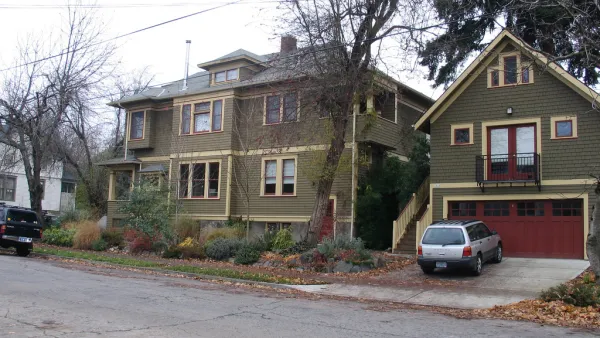
The ruling requires the city to conduct an environmental impact statement (EIS) on proposed legislation that would "loosen requirements that are currently limiting the production of mother-in-law apartments and backyard cottages, known as ADUs (accessory dwelling units) and DADUS (detached accessory dwelling units), respectively," explains Feit.
According to Feit, the ruling should come as a wakeup call for politicians, developers, and advocates who support new land use regulations that would enable additional density in parts of the city. In the Queen Anne neighborhood, the sense is that the city is being "too cavalier" with the push to add density, but advocates should expect that "[s]ingle-family neighborhoods are going to fight change every step of the way."
The article includes a lot more detail on the specifics of the Seattle and Queen Anne case study, as well as the role of accessory dwelling units in the agenda of many pro-development and affordable housing advocates.
Read the full story: Ruling Puts Hold on Adding Density to Single-Family Neighborhoods

The 'Most Pro-Housing Reform in U.S. History' Expected for Approval Today in Portland
The Portland Residential Infill Project is expected for approval by the Portland City Council today, culminating a six year process that became more and more ambitious with every iteration.
Environmental Impact Study Builds the Case for Accessory Dwelling Units in Seattle
Proponents of a new Accessory Dwelling Unit rule in Seattle say the tactics of opponents backfired with this Environmental Impact Study.
Court Ruling Deals Blows to Granny Flat Permits in Los Angeles
Granny flats, also known as mother-in-law units or accessory dwelling units, are a hot button item in most cities. A county court recently took the city of Los Angeles' finger off the button, so to speak.

Planetizen Federal Action Tracker
A weekly monitor of how Trump’s orders and actions are impacting planners and planning in America.

California plans to bury El Niño’s downpour
If the state plays its cards right, it may be able to store a billion acre-feet of El Niño’s water in aquifers.

Desperate measures: Advocates weigh draining Lake Powell to fill Colorado River
Draining the reservoir could reduce evaporation losses by a couple hundred thousand acre-feet.

Housing is the top priority of Seattle’s sole new councilmember
Jenks campaigned on building 1,000 new units of affordable housing.

New tax cuts may slash $1.5 billion in funding for Miami transit, public parks
Amendment 3 will save Miami-Dade homeowners $2,700 in 2028.

Arizona, Wisconsin, Pennsylvania hope to finally advance climate goals post-midterms
The three states have spent years under Republican or divided control.

FREE Course: Walkable City 1: Why Walkability?
After describing his path towards focusing on walkability as the essence of good planning, Jeff Speck marches through his five principal reasons for making more walkable places.
Reinventing Malls: Planning Alchemy—Turning Gray Fields Into Gold
The course focuses on the opportunities and imperatives that shape reinvention of mall sites.

City of Rosemead
Rutgers University, Edward J. Bloustein School of Planning and Public Policy
One Hundred Miles
University of Michigan School for Environment and Sustainability (SEAS)
Hunter College, City University of New York (CUNY)
The Architects Foundation
City of Cambridge
Montrose County
The Pocatello Development Authority