A coalition of local governmental agencies and advocates released their 2016 report on the condition of local streets and roads in California, and they found dire underinvestment. The legislature has yet to convene a special session on funding.


"California’s 143,000 miles of local streets and roads are deteriorating rapidly, and the average local thoroughfare across the state is rated 'at risk' because of its poor physical condition, according to a study commissioned by a coalition of local governments and their allies," reports John Howard, editor of Capitol Weekly.
Serious underinvestment
A mix of state, local and federal funds – about $1.98 billion annually – is provided for California’s streets and roads, but the minimal amount needed to maintain the existing quality is $3.5 billion, according to the study. To fix the roads to an optimum level of repair and maintenance would cost about $70 billion or more over the next 10 years, the report says.
"This study was sponsored by the cities and counties of California and managed by the Metropolitan Transportation Commission (MTC)," states the executive summary of the 2016 California Statewide Local Streets and Roads Needs Assessment. The report has been release biennially since 2008. Click here for the members of the oversight committee which included many representatives from city and county public works departments.
Local streets and roads compose over 80 percent of the state's road network
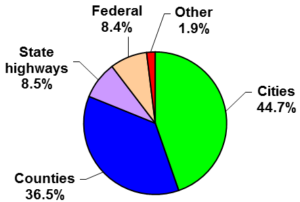
Breakdown of Road Centerline Miles by Agency. Credit: Save California Streets
Funding Sources
The report includes a section (4: pg. 42) that lists all federal, state and local pavement revenue sources. Notably absent under the latter are gas taxes, unlike cities and counties in some other states, such as Florida and Oregon. Nonetheless, the list is helpful due to its comprehensiveness.
Conclusion
"The conclusions from this study are inescapable," states the report.
Given existing funding levels available to cities and counties, California’s local streets and roads will continue to deteriorate over the next 10 years. It is alarming that local streets and roads have decayed to the point that funding will need to almost double just to maintain current conditions.
To address the funding shortfall, "Gov. Brown called for the session on July 16 [2015] but lawmakers never convened," adds Howard. The deadline for that session is Nov. 30.
To download the 223-page report [PDF], click here.
Also on Planetizen:
- California Transportation Funding Bill Stalls in Final Week, September 13, 2015
- New Study Finds California’s Local Streets and Roads In Perpetual Disrepair, October 31, 2014
Hat tip MTC News Headlines.
Read the full story: Local roads, streets in sorry shape
Three Transportation Ballot Measures Could Be Headed to Bay Area Voters Next Year
The California Legislature approved bills to allow voters to decide on hiking sales taxes and tolls for regional transportation. Gov. Jerry Brown already signed a bill to allow San Mateo County voters to hike sales taxes for transportation.
Why does Maryland's gas tax change every year?
The state's annual gas tax update may still not be enough to keep up with changes in the transportation sector and rising project costs.
Bay Area 2050+ Plan Prepares Region for Nearly 5 Feet of Sea Level Rise
The regional plan includes its first ever resilience project list, prioritizing infrastructure projects that can protect the area from sea level rise.

Planetizen Federal Action Tracker
A weekly monitor of how Trump’s orders and actions are impacting planners and planning in America.

Washington state to charge fee to drivers with fuel-efficient cars
Revenue from the fee will go towards supporting the state’s highways.

Study reveals best places in the U.S. for cycling, walking
New research from Streetlight Data examines bicycle and pedestrian miles per capita in the 100 largest U.S. cities by population.

Mamdani unveils his ‘most ambitious bus lane project’ so far
The city has added two new bus lanes, which it expects to speed up tens of thousands of bus riders’ commutes.

New Jersey and New York suggest $10.3 billion budget for transit
Some of the budget is dedicated to replacing Manhattan's Midtown Bus Terminal.

States split over EPA’s proposal to drop greenhouse gas rules for power plants
The proposed rule drew over 165K comments, including from officials, health and environmental groups, and private citizens.

FREE Course: Walkable City 1: Why Walkability?
After describing his path towards focusing on walkability as the essence of good planning, Jeff Speck marches through his five principal reasons for making more walkable places.
Reinventing Malls: Planning Alchemy—Turning Gray Fields Into Gold
The course focuses on the opportunities and imperatives that shape reinvention of mall sites.

City of Charlotte
City of Rosemead
Rutgers University, Edward J. Bloustein School of Planning and Public Policy
University of Michigan School for Environment and Sustainability (SEAS)
Hunter College, City University of New York (CUNY)
The Architects Foundation
University District Partnership
City of Cambridge
The Pocatello Development Authority