The city of Woodland, Washington, offers a case study in government funding. Voters there will consider a sales tax as part of its transportation benefit district, but the benefit could extend to the police department as well.


"When Woodland residents vote in November, they’ll have the opportunity to approve a 0.2 percent sales tax for transportation projects, reports Adam Littman.
"The tax, to be applied on top of the city’s existing 7.8 percent rate, comes from the transportation benefit district that formed in June," adds Littman. The state law's allowance of transportation benefit districts means Woodland's action could follow in the footsteps of previous benefit districts like those in Battle Ground and Vancouver, both located in Clark County.
The aim of the new tax, however, is far from the transit taxes that attract media attention in large cities around the country. Littman explains:
A major reason for the transportation benefit district was to fund roadwork and free up money for the Woodland Police Department. [Mayor Will] Finn said money is now diverted to roadwork from the city’s general fund, but if the city can find some other revenue source for transportation, more money can go to the police department.
So while the police department would have more money for hiring, the transportation benefit district would continue funding projects like "sidewalk and curb replacement or repairs, chip seal and pavement maintenance/repair, pavement overlays, [the] Scott Avenue reconnection and the city’s six-year capital projects plan."
Read the full story: Woodland’s fledging transportation benefit district awaits vote on sales tax
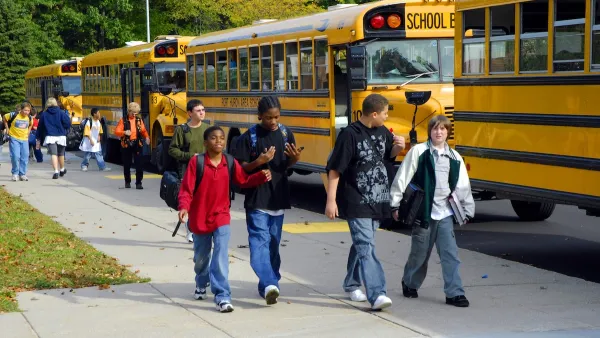
Learning loss and urban schools, part 2
Did test scores in progressive cities drop more post-COVID than test scores in moderate ones?
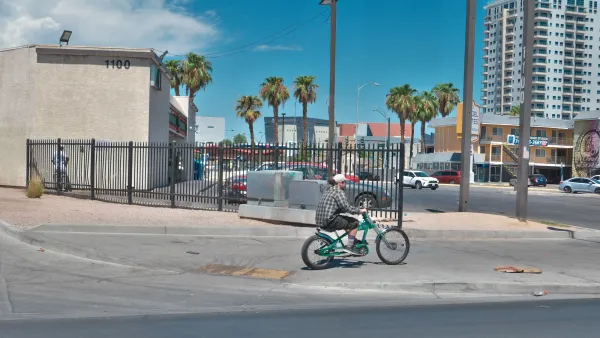
Las Vegas is building its first protected bike lane
The new lane connects Henderson and the Las Vegas Raiders headquarters via Starr Avenue.
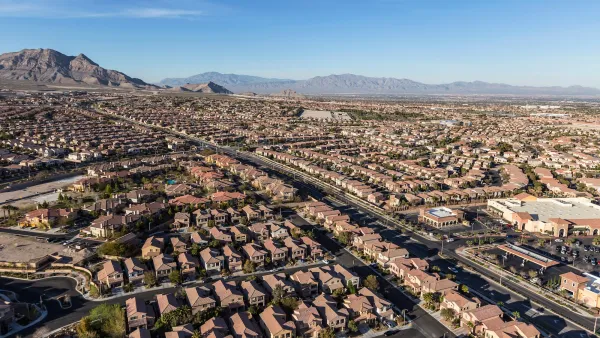
Nevada is no Longer a Haven of Housing Affordability
Large investors own 11 percent of single-family rentals in Las Vegas — far above the national average of 3 percent.

Planetizen Federal Action Tracker
A weekly monitor of how Trump’s orders and actions are impacting planners and planning in America.

California plans to bury El Niño’s downpour
If the state plays its cards right, it may be able to store a billion acre-feet of El Niño’s water in aquifers.

Desperate measures: Advocates weigh draining Lake Powell to fill Colorado River
Draining the reservoir could reduce evaporation losses by a couple hundred thousand acre-feet.

Mamdani’s pied-à-terre tax survives legal challenge
A panel of judges found that the plaintiffs failed to demonstrate injury as a result of New York City's implementation of the tax.

Eastern Nebraska is running out of electricity
Data centers and electrification are straining eastern Nebraska’s grid, throttling economic development.

Seattle passes record-breaking transit services expansion
Proposition 1 will double the city’s transit tax to add 95,000 more bus trips and preserve 180,000 bus trips annually.

FREE Course: Walkable City 1: Why Walkability?
After describing his path towards focusing on walkability as the essence of good planning, Jeff Speck marches through his five principal reasons for making more walkable places.
Reinventing Malls: Planning Alchemy—Turning Gray Fields Into Gold
The course focuses on the opportunities and imperatives that shape reinvention of mall sites.

City of Rosemead
Rutgers University, Edward J. Bloustein School of Planning and Public Policy
One Hundred Miles
University of Michigan School for Environment and Sustainability (SEAS)
Hunter College, City University of New York (CUNY)
The Architects Foundation
City of Cambridge
Montrose County
The Pocatello Development Authority