L.A.’s pandemic-era renter protections are credited with stabilizing homelessness in the region, but they ended at the end of March. Meanwhile, evictions are on the upswing around the country, led by L.A.’s neighbor to the east, Las Vegas.


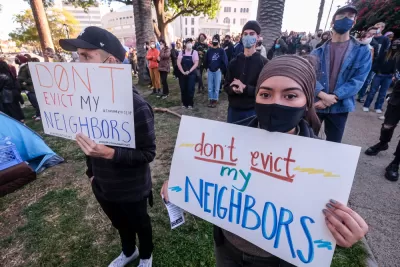
Pandemic-era renter protections ended recently in Los Angeles County, just over three years after they were created to protect vulnerable residents during the uncertainty and upheaval of the early days of Covid-19.
“Elected leaders, such as L.A. Mayor Karen Bass, and local homeless service providers say they’re bracing for a wave of evictions across the region after the COVID-19 renter safeguards expire,” according to an article by David Wagner for LAist. In fact, according to recent U.S. Census Bureau survey data, “An estimated 246,000 renter households in the L.A. area were already behind on rent ahead of the [recent] deadline.”
The fear is that the loss of renter protections, including eviction protections, could increase the number of people experiencing homelessness in a county where 69,000 people are unhoused. As noted by Wagner, homelessness figures in the region actually stabilized during the pandemic, potentially thanks to the robust social safety net put in place during the pandemic.
“Until now, economic harms from the pandemic served as a defense from eviction for low-income renters in L.A. County who couldn’t pay rent on time. Starting Saturday, renters living anywhere in the county will no longer be able to cite COVID-19 as a reason to delay rent payments,” writes Wagner.
The proof that the eviction protections worked in L.A. County is in the data. According to data from the Los Angeles Sherrif Department, obtained by LAist, evictions fell by 85 percent in the last nine months of 2020 compared to the same period in 2019.
Las Vegas Leads the Nation in Evictions
Los Angeles County rescinded its Covid-19 renter protections a few days before new data emerged about the rising rate of evictions around the country.
“Following two years of temporary bans and rental assistance programs prompted by the COVID-19 pandemic, evictions skyrocketed across the United States in 2022. Court filings rose by double- or triple-digit percentages in 32 metro areas tracked by Eviction Lab, a research group at Princeton University. Overall, 14 cities saw more filings than would have been normal before the pandemic, with Las Vegas leading the pack,” according to a separate article by Michael Scott Davidson for Newsweek.
Las Vegas, located just a few hours drive away from Los Angeles, handled 57,000 eviction cases in 2022, a steep climb from its traditional annual average of 36,500 eviction filings.
The consequences of evictions can be catastrophic for renters. “Beyond the immediate threat of homelessness, many landlords won't rent to people with an eviction on their record, limiting housing options for years to come. Once they find a new place to live, displaced families often enroll their children in new schools and travel further to work,” according to Davidson.
A Nationwide Eviction Trend
The rising number of evictions is far from unique to the Southwest United States, however. According to Davidson, eviction filings increased fivefold between 2021 and 2022 in Minneapolis and Austin. And “They more than doubled in Houston, Philadelphia and New York—although only Houston has passed pre-pandemic levels,” reads the article.
Add the risk of eviction to a collection of economic concerns for vulnerable renters, including inflation and the rising cost of rents.
FULL STORY: After Three Years, LA County Ends Eviction Protections For Renters Harmed By COVID

Los Angeles opens public housing waitlist for first time in over two years
The 16 properties with newly available waitlist spots accept families and senior residents.

Las Vegas is building its first protected bike lane
The new lane connects Henderson and the Las Vegas Raiders headquarters via Starr Avenue.

LA County's 'Beach Bus' offers $6 round-trip rides from inland LA to the beach
The annual summer service shuttles residents from eastside communities to Santa Monica.

The state-sanctioned urbicide of Austin
People don’t kill cities. Freeways do.

US to reduce Colorado River water deliveries to Mexico
A new Colorado Treaty amendment reduces Mexico’s Colorado River water allocation by 250,000 acre feet.

New Jersey’s second-largest city bans standalone data centers
Jersey City will continue to allow co-location facilities, such as those meant for research institutions that store their own data.

Amtrak not solely to blame for New Jersey commuter rail's unreliability, report finds
A new study from the Garden State Initiative found that NJ Transit’s budget grew 20% across a 4 year period, but reliability declined significantly over the same period.

EPA erases limits on planet-warming pollution from power plants
Under Monday’s plan, power plants would still have some limits on how much mercury, arsenic and other contaminants they can emit.

Phoenix announces new on-demand transit service, more frequent RAPID buses
Both new services will launch in October, and are part of Phoenix's Project Effective Access Solutions for Easing Congestion.

FREE Course: Walkable City 1: Why Walkability?
After describing his path towards focusing on walkability as the essence of good planning, Jeff Speck marches through his five principal reasons for making more walkable places.
Reinventing Malls: Planning Alchemy—Turning Gray Fields Into Gold
The course focuses on the opportunities and imperatives that shape reinvention of mall sites.

Eagle County Government
Harvard University Graduate School of Design
Nashville Planning Department
The Architects Foundation
University of Cincinnati Online
The Pocatello Development Authority
The Urban Renewal Agency of the City of Pocatello
Journal of the American Planning Association