In an effort to normalize biking and teach kids how to bike safely in the city, Seattle's Cascade Bicycle Club has built a small bike park that simulates road conditions.


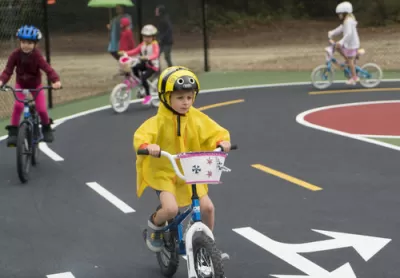
A few miles outside of Seattle, the Cascade Bicycle Club has built something completely new to the US. Their traffic garden is, "A place that mimics real-life street conditions and that’s out of harm’s way," says Jonathan Maus of Bike Portland.
The garden is a lot more than a few cones and some chalk, they've made a kind of mini-city. "The project replaced two unused tennis courts and turned them into a smartly designed streetscape complete with crosswalks, multi-lane roads, a roundabout, and more. The idea was to create a place where kids and adults can practice safe riding skills in a realistic environment away from the dangers posed by other road users." The garden's designer, Steve Durrant, says he, "tried to include many different traffic scenarios in the space: stop lines, crosswalks, lane merging, a roundabout, a one-way loop, and so on."
While such places are common in Europe, the piece reports that this is the first of these gardens in the US.
Read the full story: Seattle’s new traffic garden is the perfect place to learn the rules of the road

Seattle Recorded Zero Bike Deaths in 2024, per Early Data
The city halved the number of pedestrian deaths compared to 2021.
A Simple Fix for Blocked Bike Lanes
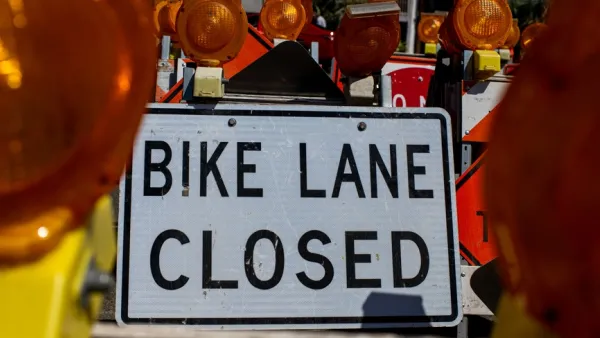
A bike lane detour in Seattle illustrates a cheap and easy way to safely direct bike traffic around obstructions such as utility work.
Bike Helmets No Longer Required in Seattle After Research Reveals Enforcement Disparities
The data on bike helmets have changed. Laws are starting to change too.

Planetizen Federal Action Tracker
A weekly monitor of how Trump’s orders and actions are impacting planners and planning in America.

California plans to bury El Niño’s downpour
If the state plays its cards right, it may be able to store a billion acre-feet of El Niño’s water in aquifers.

Desperate measures: Advocates weigh draining Lake Powell to fill Colorado River
Draining the reservoir could reduce evaporation losses by a couple hundred thousand acre-feet.

California city breaks ground on transit connector
The project includes three mobility hubs and a pedestrian bridge.

After public outcry, Massachusetts city releases housing development tracker
Cambridge’s tracker currently shows 250 housing projects in various stages of development.

40 years after approval, Chicago breaks ground on new park
The park honors Jean Baptiste Point du Sable, the city’s first permanent non-native settler.

FREE Course: Walkable City 1: Why Walkability?
After describing his path towards focusing on walkability as the essence of good planning, Jeff Speck marches through his five principal reasons for making more walkable places.
Reinventing Malls: Planning Alchemy—Turning Gray Fields Into Gold
The course focuses on the opportunities and imperatives that shape reinvention of mall sites.

City of Rosemead
Rutgers University, Edward J. Bloustein School of Planning and Public Policy
One Hundred Miles
Hunter College, City University of New York (CUNY)
The Architects Foundation
University of Cincinnati Online
City of Cambridge
Montrose County
The Pocatello Development Authority