Maryland Governor Larry Hogan has thrown support behind a study to add a third span to the Bay Bridge that spans the Chesapeake Bay.


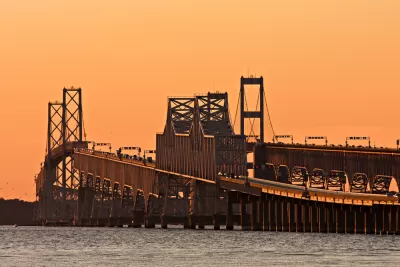
"Gov. Larry Hogan said Tuesday that the state will spend $5 million and up to four years studying where to put — and how to pay for — a possible third span across the Chesapeake Bay," reports Erin Cox. The bridge could potentially cost $6.85 billion.
"The congested and aging Bay Bridge has vexed transportation planners for decades," according to Cox. Apparently the construction of the bridge is still sturdy, and will remain so until 2065. "But increased traffic is projected to cause daily 13-mile backups by 2040 unless a new span is built." The bridge currently carries about 70,000 vehicles a day. That total is expected to grow to 92,000 by 2040. The Bay Bridge "carries U.S. 50 and 301 from Anne Arundel County on the Western Shore across the Chesapeake to Queen Anne's County on the Eastern Shore," according to Cox.
The Hogan Administration has taken congestion relief considerations further than previous politicians by commissioning this study, and Governor Hogan has shown support for highway projects in the past, while also refusing to fund the now defunct $2.9 billion Baltimore Red Line light rail project.
Read the full story: Hogan announces plan to study building third Bay Bridge span
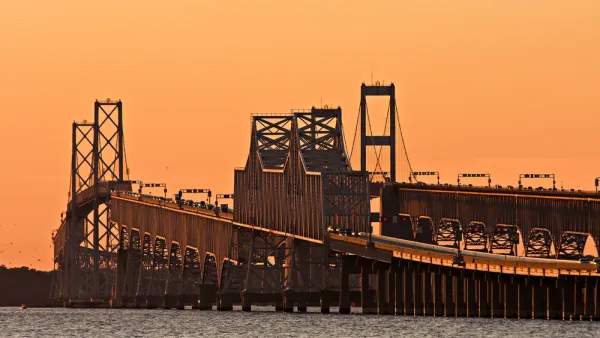
14 Potential Locations for a New Bridge Across the Chesapeake Bay
A long term plan to add an additional bridge connection across the Chesapeake Bay is underway in Maryland.
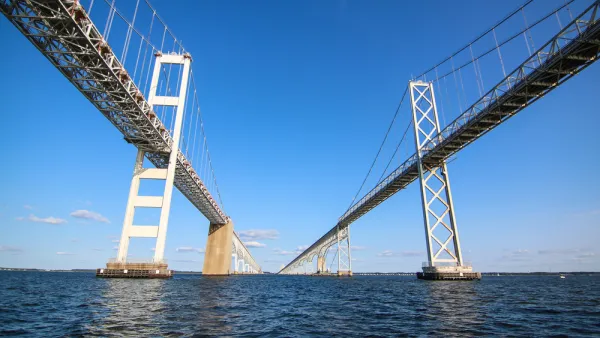
Potential Routes for New Bridge Across the Chesapeake Winnowed From 14 to 3
The Maryland Transportation Authority has been studying the potential of a new bridge across the Chesapeake Bay, connecting Annapolis to Queen Anne's County to the East.
Editorial: The Best New Chesapeake Bay Bridge Is No New Chesapeake Bay Bridge
The Baltimore Sun Editorial Board finds numerous faults with the state of Maryland's preliminary investigation of an idea to add another bridge across the Chesapeake Bay near Annapolis.

Planetizen Federal Action Tracker
A weekly monitor of how Trump’s orders and actions are impacting planners and planning in America.

California plans to bury El Niño’s downpour
If the state plays its cards right, it may be able to store a billion acre-feet of El Niño’s water in aquifers.

Desperate measures: Advocates weigh draining Lake Powell to fill Colorado River
Draining the reservoir could reduce evaporation losses by a couple hundred thousand acre-feet.

Chicago voters approve permanent festival grounds, penalty for vacant property owners
Currently, major summer and fall festivals take over public parks for weeks at a time, drawing criticism from nearby residents

NYC votes to cut outdoor dining red tape, speed up permitting
New York City also voted to allow the Department of Transportation to begin work on urgent projects before notifying elected officials.

California appears to reject Prop. 45
The proposition would have expanded the projects that qualify for a streamlined environmental review, effectively paring down the California Environmental Quality Act.

FREE Course: Walkable City 1: Why Walkability?
After describing his path towards focusing on walkability as the essence of good planning, Jeff Speck marches through his five principal reasons for making more walkable places.
Reinventing Malls: Planning Alchemy—Turning Gray Fields Into Gold
The course focuses on the opportunities and imperatives that shape reinvention of mall sites.

City of Rosemead
Rutgers University, Edward J. Bloustein School of Planning and Public Policy
One Hundred Miles
Hunter College, City University of New York (CUNY)
The Architects Foundation
University of Cincinnati Online
City of Cambridge
Montrose County
The Pocatello Development Authority