The same political force that helped bring the Central Subway in San Francisco is now opposing a proposal that grew in the project's wake—turning Stockton Street into a permanent pedestrian space.


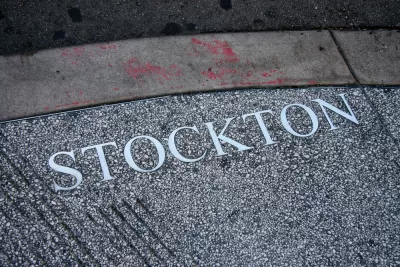
Matier & Ross report from San Francisco that a Chinatown political activist named Rose Pak is marshaling forces to obstruct a proposal to turn lower Stockton Street into a pedestrian walkway.
"The idea of turning lower Stockton Street into a permanent pedestrian space — possibly with a provision for buses — has been percolating since the city tore up the once heavily traveled link between Chinatown and Market Street five years ago to build the Central Subway," according to Matier & Ross. Business in the area suffered while subway work was underway, so the city compromised by suspending work during the holiday season and "turning the three-block stretch between Market and Post streets into an artificial-turf-covered walkway complete with benches, food trucks and nighttime light shows."
Union Square merchants support the proposal to permanently turn Stockton Street into a pedestrian-only space, but Pak disagrees. She's opposing a preliminary study on the proposal, arguing that Stockton Street is "a vital link in and out of Chinatown that needs to be restored to its old self as soon as possible."
Read the full story: Rose Pak flashes red light on Stockton Street pedestrian mall
Waymo Gets Permission to Map SF’s Market Street
If allowed to operate on the traffic-restricted street, Waymo’s autonomous taxis would have a leg up over ride-hailing competitors — and counter the city’s efforts to grow bike and pedestrian on the thoroughfare.
Where Pandemic Bike Improvements Won Out
While some cities are reverting back to pre-pandemic street configurations, others are taking advantage of the momentum for bike and pedestrian infrastructure to make pandemic-era projects permanent.
Predictions for San Francisco’s Public Spaces
In 2023, will the city’s public spaces be reclaimed by cars, or will pandemic-era interventions lead to permanent change?

Planetizen Federal Action Tracker
A weekly monitor of how Trump’s orders and actions are impacting planners and planning in America.

California plans to bury El Niño’s downpour
If the state plays its cards right, it may be able to store a billion acre-feet of El Niño’s water in aquifers.

Desperate measures: Advocates weigh draining Lake Powell to fill Colorado River
Draining the reservoir could reduce evaporation losses by a couple hundred thousand acre-feet.

Los Angeles just elected an urban planner as its mayor
Transportation analysts are optimistic that Raman will be more aggressive in addressing transit issues than Bass.

Mamdani’s pied-à-terre tax survives legal challenge
A panel of judges found that the plaintiffs failed to demonstrate injury as a result of New York City's implementation of the tax.

Eastern Nebraska is running out of electricity
Data centers and electrification are straining eastern Nebraska’s grid, throttling economic development.

FREE Course: Walkable City 1: Why Walkability?
After describing his path towards focusing on walkability as the essence of good planning, Jeff Speck marches through his five principal reasons for making more walkable places.
Reinventing Malls: Planning Alchemy—Turning Gray Fields Into Gold
The course focuses on the opportunities and imperatives that shape reinvention of mall sites.

City of Rosemead
Rutgers University, Edward J. Bloustein School of Planning and Public Policy
One Hundred Miles
University of Michigan School for Environment and Sustainability (SEAS)
Hunter College, City University of New York (CUNY)
The Architects Foundation
City of Cambridge
Montrose County
The Pocatello Development Authority