Seventy-five new buses hit the streets of Queens in May, but none of them have transit signal priority technology, proven to improve travel times, on board.


Vincent Barone reports: "None of the 75 blue and yellow buses that rolled out in Queens this May -- part of a fleet of 2,042 coming to city streets over the next six years -- are equipped with technology known as Traffic Signal Prioritization, or TSP."
TSP software uses GPS give buses more green lights and fewer reds. "As buses approach intersections, the city’s traffic control center can hold green lights or speed up a red light cycle to prevent idling," according to Barone.
According to the New York City Department of Transportation, TPS is already installed on several routes around the city, resulting in travel time improvements between ten and 15 percent. Barone notes that the priority on WiFi, rather than the service performance improvements enabled by TSP, does not reflect the desires of bus users, as reported in a survey by TransitCenter released in July.
Read the full story: New MTA buses have Wi-Fi, but lack technology to speed travel time

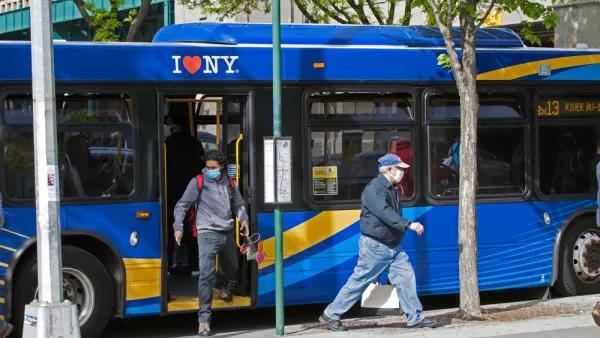
All-Door Boarding Stuck in Neutral in New York City
MTA leadership has decided all-door boarding will lead to fare evasion and isn’t willing to adopt a program that was already well underway.
Can New York Legislators Make Buses Free While Improving Service?
A pair of state legislators hope to make buses free while improving service levels on the Metropolitan Transportation Authority’s (MTA) bus system in New York City. The effort will require a new level of political will for transit.
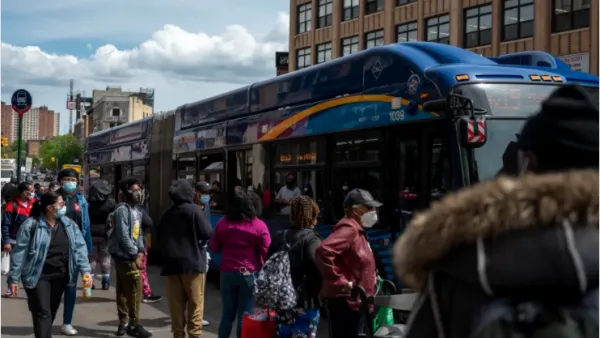
Plans to Speed Up Buses Slowed as the City Gets Set to Reopen
An ambitious plan hatched during the pandemic in New York City would have copied the success of the 14th Street Busway. The city has slowly retreated from the plan's original scope since the announcement of the plan in June 2020.

Planetizen Federal Action Tracker
A weekly monitor of how Trump’s orders and actions are impacting planners and planning in America.

Amtrak, CN end decades-long dispute with eight-year agreement
The new operating agreement establishes an updated framework for the companies to work together, including processes to resolve disputes.

Northwest rail fans eager for Sept. 30 debut of Amtrak’s Airo fleet
Get ready for that new train smell and more seats. But they won’t go faster or run more frequently on the Cascades route in Washington and Oregon.

St. Louis Metro to test if single-car trains can reduce operating costs, maintain rider satisfaction
The pilot program will run from October to spring 2027, and begin with one single-car train operating on Metrolink’s Red and Blue lines.

Pennsylvania is building data centers in abandoned mines
Housing data centers in mines provides an alternative to destroying local forests and may spare residents from data centers’ noise and air pollution.

If Corpus Christi can’t revive desalination plant project, it may owe Texas $235 million
Earlier this month, city officials declined to pursue developing the plant for the second time in a year.

FREE Course: Walkable City 1: Why Walkability?
After describing his path towards focusing on walkability as the essence of good planning, Jeff Speck marches through his five principal reasons for making more walkable places.
Reinventing Malls: Planning Alchemy—Turning Gray Fields Into Gold
The course focuses on the opportunities and imperatives that shape reinvention of mall sites.

City of Thousand Oaks
City of Wisconsin Rapids
Harvard University Graduate School of Design
The Architects Foundation
University of Cincinnati Online
The Pocatello Development Authority
The Urban Renewal Agency of the City of Pocatello