Bike advocates have Copenhagen to provide a real-world case study of a multi-modal vision of the future. It's time bus advocates had their own exemplar.


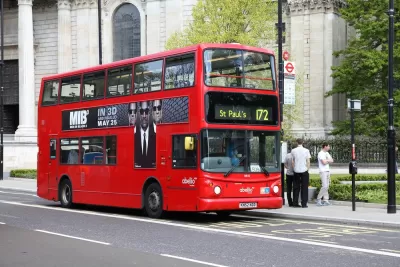
Daniel Hertz writes an appeal on behalf of buses that takes a cue from the example of the impact that Copenhagen has had on the proliferation of bike infrastructure around the United States and the world.
Where bike advocates could Copenhagenize, bus advocates should borrow a model from a different European city and "Londonize," according to Hertz.
Hertz lists the reasons London could serve as the aspirational global model of bus transit—its iconic double deckers and its impressive scale (moving more people, at 2.3 billion passengers a year, than the London Tube (1.3 billion) and almost as many as the New York Subway (2.8 billion)).
To achieve its model successes, Transport for London operates its buses on four pillars, suggested by Hertz as a good place to start to revolutionize bus transit in the United States: Frequency, Reliability, Simplicity, and Comprehensiveness.
Read the full story: Londonize!

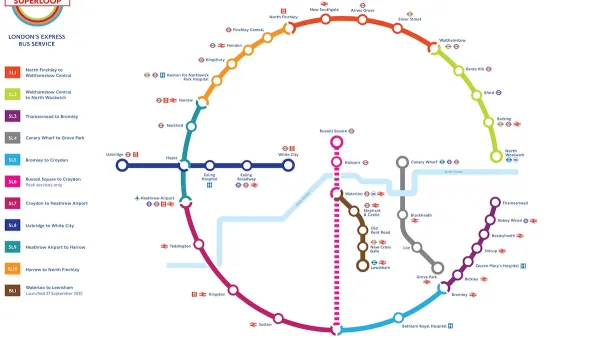
London’s Superloop BRT Ridership Grows by 20% While Other Bus Ridership Declines
The new rapid bus system launched its first suburban line, the first of 10 that will extend outside central London.

This is How the British Started Cycling More
Cycling has never felt more relevant or encouraged in the UK. Since May, the London Councils have upgraded 60 km of bike lanes in the capital city, added 20,000 square metres of extra pavement space, and installed 1,500+ additional cycle parking.
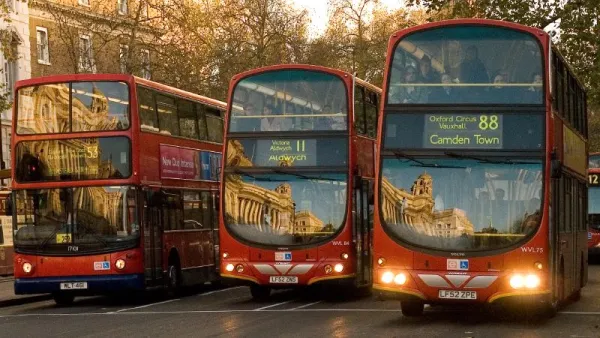
Is London Neglecting Its Most Popular Mode of Public Transport?
Carrying 2.3 billion passengers a year, London's buses are the most popular they've been in more than fifty years and 60 percent more utilized than in 2000. Is the city doing enough to plan for future demand and threats to service?

Planetizen Federal Action Tracker
A weekly monitor of how Trump’s orders and actions are impacting planners and planning in America.

Amtrak, CN end decades-long dispute with eight-year agreement
The new operating agreement establishes an updated framework for the companies to work together, including processes to resolve disputes.

Nation's most wind-powered state turns to coal as data centers increase energy demand
For the first time in decades, Iowa has increased its generation of coal power.

Alabama scores up to $2.5 billion federal loan for largest infrastructure project in state’s history
The Mobile River Bridge and Bayway Project aims to ease congestion at Alabama’s worst bottleneck.

Trump is considering data centers on 6 states' public land — some state officials say they had no idea
If the administration approves the proposed projects, data center and data center-related developments will cover 17,600 acres of public land.

Despite court ruling, Trump is keeping nearly all wind projects in the US on hold
At least 110 wind energy projects have not heard from the government since a federal judge ruled that the Trump administration's freeze on wind turbine clearances was likely illegal.

FREE Course: Walkable City 1: Why Walkability?
After describing his path towards focusing on walkability as the essence of good planning, Jeff Speck marches through his five principal reasons for making more walkable places.
Reinventing Malls: Planning Alchemy—Turning Gray Fields Into Gold
The course focuses on the opportunities and imperatives that shape reinvention of mall sites.

KFH Group Inc.
Greater Baltimore Committee
Eagle County Government
The Architects Foundation
University of Cincinnati Online
The Pocatello Development Authority
The Urban Renewal Agency of the City of Pocatello