The Eno Center for Transportation lays out a clear appeal for action to regulate the time, place, and manner of digital billboards.


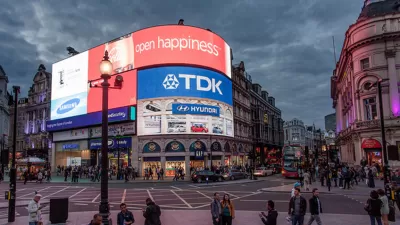
Jerry Wachtel shares the findings of "an extensive review [pdf] of research showing that digital billboards are more distracting than traditional signs…" Furthermore, the review finds "that driver attention is particularly captured by changes between advertisements, which typically occur every six or eight seconds."
After citing a few examples of research finding evidence of the distractions caused by digital billboards, Wachtel goes on to note the flip side of the scientific inquiry: a lack of attention paid to the safety risks posed by such signs. On exception to that lack of attention, at least, is a forthcoming series of Research Needs Statements, to be released by the Digital Billboards Subcommittee of the Transportation Research Board. Those Research Needs Statements will "address some of the most egregious aspects of digital billboards." In the meantime, Wachtel writes, "the U.S. Department of Transportation and state agencies should not wait to begin to work with advocates and constituency organizations on new guidance regarding the time, place, and manner of such displays."
Read the full story: Studies Raise Safety Questions about Distractions from Digital Billboards
Historically Redlined Neighborhoods Have Higher Rates of Pedestrian Deaths, Study Says
The consequences of historic redlining continue to have consequences in the present day United States. Add another example to the list.

Study: Uber Doesn't Reduce Drunk Driving Fatalities
The debate about the benefits of transportation network companies, like Uber, continues.
January Must-Reads: Top 10 Articles From Last Month
How a tidal wave of potential changes at the federal level could throw many programs planners depend on into chaos, a roundup of last year’s zoning stories, and the continuing ripple effects of a landmark Supreme Court case.

Planetizen Federal Action Tracker
A weekly monitor of how Trump’s orders and actions are impacting planners and planning in America.

Eastern Nebraska is running out of electricity
Data centers and electrification are straining eastern Nebraska’s grid, throttling economic development.

Move over, LA: St. Louis gears up for Olympics, invests millions in downtown redevelopment
The Missouri city will host the 2028 Olympic soccer group stage and knockout matches.

Dallas releases zoning code overhaul to officials
The drafted overhaul is over 400 pages long.

NYC renovations for dangerous, ‘mercilessly crammed’ street delayed until 2027
Construction was supposed to begin this fall.

San Diego’s Midway Rising project gets greenlight from city council
The project looks to become the largest affordable housing development in California's history.

FREE Course: Walkable City 1: Why Walkability?
After describing his path towards focusing on walkability as the essence of good planning, Jeff Speck marches through his five principal reasons for making more walkable places.
Reinventing Malls: Planning Alchemy—Turning Gray Fields Into Gold
The course focuses on the opportunities and imperatives that shape reinvention of mall sites.

City of Rosemead
Rutgers University, Edward J. Bloustein School of Planning and Public Policy
One Hundred Miles
University of Michigan School for Environment and Sustainability (SEAS)
Hunter College, City University of New York (CUNY)
The Architects Foundation
City of Cambridge
The Pocatello Development Authority
The Urban Renewal Agency of the City of Pocatello