While a federally-funded network of bike paths is in the works elsewhere in the city, the Major Taylor Trail gets little use from Chicago residents. The main problems are a lack of awareness and the South Side's fearsome reputation.


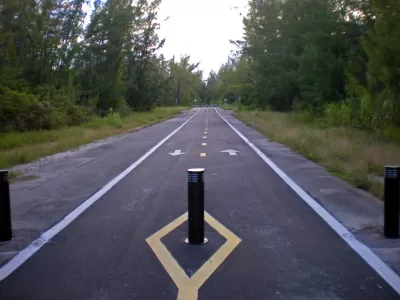
Many Chicago bike enthusiasts frequent the 606, a popular path following an old railroad bed on the Northwest Side. But to the south, the Major Taylor Trail gets little love, though it was built eight years earlier. Mary Wisniewski discusses why that is.
In many respects, Chicagoan cyclists enjoy a widening array of options. One of them is the Cal-Sag trail and the adjacent 86-mile Southland Century bike loop. "The Major Taylor will link to the popular Cal-Sag Trail, being built with $21 million of mostly federal funds. [...] If all goes as planned, in 2018 the Cal-Sag will be the northern leg of a mostly off-road loop that will include the Old Plank Road, Thorn Creek, Centennial and I&M Canal trails and the Burnham and Pennsy greenways."
The biggest drawback for the Major Taylor is crime, or the perception of it. Snaking through low-slung less well-off suburbs of color, the Major Taylor Trail feels deserted. "The trail's solitude adds to the feeling of insecurity: The southern end leading to the Little Calumet River is lovely but on a quiet weekday feels like Fangorn Forest in 'The Lord of the Rings' — vaguely unsettling."
More users means a safer trail, but users won't show up until they think the trail's safe. A catch-22. Meanwhile, "Supporters keep publicizing the trail through the bike community, social media and holding group events to get more people to try it."
Read the full story: Why the Major Taylor isn't as well-known — or used — as The 606

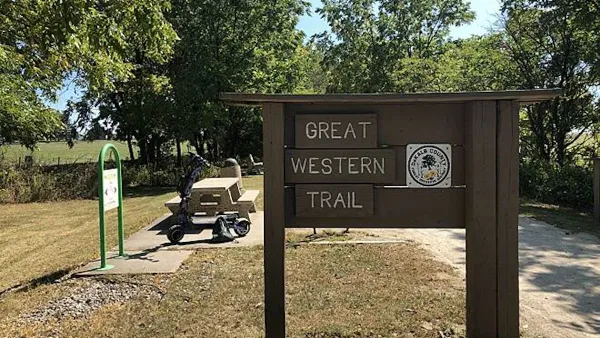
Advocates Champion the Great Western Trail
A Chicago walking and biking trail along a former railroad right-of-way has been a labor of love for local residents.

Chicago bike lane projects spark backlash from businesses, gentrification fears
A battle is brewing over Chicago's street space.
Trump has Slashed Over $750 Million From Bike and Walking Trail Projects
The Trump administration is pulling hundreds of millions allocated under the 2022 Inflation Reduction Act.

Planetizen Federal Action Tracker
A weekly monitor of how Trump’s orders and actions are impacting planners and planning in America.

Amtrak, CN end decades-long dispute with eight-year agreement
The new operating agreement establishes an updated framework for the companies to work together, including processes to resolve disputes.

Nation's most wind-powered state turns to coal as data centers increase energy demand
For the first time in decades, Iowa has increased its generation of coal power.

Alabama scores up to $2.5 billion federal loan for largest infrastructure project in state’s history
The Mobile River Bridge and Bayway Project aims to ease congestion at Alabama’s worst bottleneck.

Trump is considering data centers on 6 states' public land — some state officials say they had no idea
If the administration approves the proposed projects, data center and data center-related developments will cover 17,600 acres of public land.

Despite court ruling, Trump is keeping nearly all wind projects in the US on hold
At least 110 wind energy projects have not heard from the government since a federal judge ruled that the Trump administration's freeze on wind turbine clearances was likely illegal.

FREE Course: Walkable City 1: Why Walkability?
After describing his path towards focusing on walkability as the essence of good planning, Jeff Speck marches through his five principal reasons for making more walkable places.
Reinventing Malls: Planning Alchemy—Turning Gray Fields Into Gold
The course focuses on the opportunities and imperatives that shape reinvention of mall sites.

KFH Group Inc.
Greater Baltimore Committee
Eagle County Government
The Architects Foundation
University of Cincinnati Online
The Pocatello Development Authority
The Urban Renewal Agency of the City of Pocatello