Suburban retrofit: what's next in issues, approaches, strategies, and tools.


"Local and regional governments in outlying areas are beginning to recognize the advantages of reversing sprawl — and the risks of not acting."
"America has about twelve thousand square miles of land, an area equivalent to the states of Connecticut and New Jersey, that are used for surface parking, loading, storage, and other nonstructural uses. The supply of this land is so vast that nearly all of America’s new nonresidential spaces and nearly all new multilevel attached residential units can easily occur on the parking lots of existing nonresidential development, especially along commercial corridors and in suburban centers."
Ben Brown quotes Lynn Richards, Arthur Nelson, Rob Steuteville, the Urban Land Institute, and Galina Tachieva as he gives us the latest on suburban retrofit and sprawl repair.

An early retrofit of an outmoded suburban mall, Mashpee Commons began its transformation, with DPZ & Co. as design lead, in the late 1980s. It has evolved into a mixed-use core for an emerging town where once there was centerless suburbia. Image Credit: DPZ & Co.
Read the full story: The Next Frontier for Compact Walkability? It’s gotta be the burbs

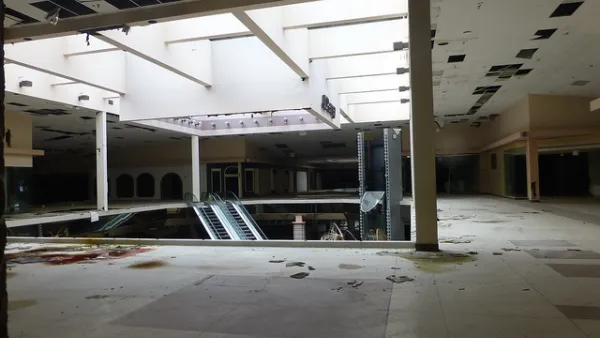
How To: Makeovers for Struggling Malls
Lean Urbanism recently released a "lean" guide to sprawl repair—focusing on how to bring struggling shopping malls back to life.
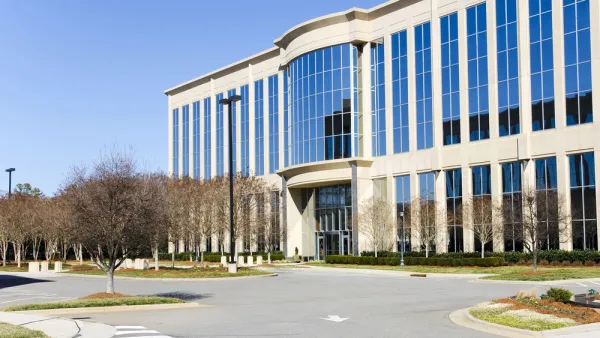
A Deep Dive into Suburban Retrofits
An interview with Ellen Dunham-Jones, co-author of "Retrofitting Suburbia," and Hazel Borys.

What an Innocuous Piece of Plastic Says About Our Suburban Future
Suburban Starbucks models are bumming urbanists out. But they also served as a nice allegory of what the future there might hold. Scott Doyon's latest blog post explains.

Planetizen Federal Action Tracker
A weekly monitor of how Trump’s orders and actions are impacting planners and planning in America.

California plans to bury El Niño’s downpour
If the state plays its cards right, it may be able to store a billion acre-feet of El Niño’s water in aquifers.

Chicago breaks ground on $3 billion megadevelopment
The new neighborhood, titled Foundry Park, will one day host 3,700 residences.

Desperate measures: Advocates weigh draining Lake Powell to fill Colorado River
Draining the reservoir could reduce evaporation losses by a couple hundred thousand acre-feet.

This road in NYC is infamously dangerous — and Mamdani can't fix it
New York City's Ocean Parkway is known for reckless driving, but the power to implement safety measures lies with the state rather than the city.

One of Denver’s busiest corridors to gain BRT
The project will span 18 miles and contain 74 bus rapid transit stations.

FREE Course: Walkable City 1: Why Walkability?
After describing his path towards focusing on walkability as the essence of good planning, Jeff Speck marches through his five principal reasons for making more walkable places.
Reinventing Malls: Planning Alchemy—Turning Gray Fields Into Gold
The course focuses on the opportunities and imperatives that shape reinvention of mall sites.

City of Rosemead
Rutgers University, Edward J. Bloustein School of Planning and Public Policy
One Hundred Miles
Hunter College, City University of New York (CUNY)
The Architects Foundation
University of Cincinnati Online
City of Cambridge
Montrose County
The Pocatello Development Authority