An interview with Ellen Dunham-Jones, co-author of "Retrofitting Suburbia," and Hazel Borys.


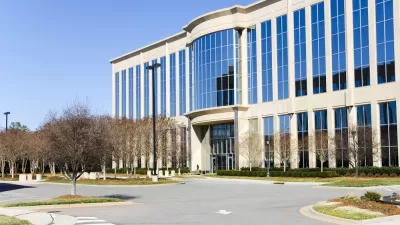
"Q2: You offer up a pithy summary of the US market, noting that of the 1,100 shopping malls, one third are dead or dying. The 50,000 strip malls have a 11% vacancy rate. Within the 350,000 big box stores, 300 million square feet are vacant. However, you point out these dynamics have been around awhile, with the newest marker being the suburban office vacancy rates of 16-24%. What has changed to make these suburban offices less attractive?"
"There are several converging factors here. The one most frequently cited by CEOs is the need to relocate to the cities that are attracting the educated 25-34 year-olds that they most want to hire and who, for the most part, find the idea of working in a Dilbert-like suburban cubicle un-creative and toxic. Additional factors include the fact that computers have automated many of the clerical jobs that used to be done in the suburban back-offices at the same time that space/employee standards have significantly reduced. The wave of ’80′s office parks and corporate campuses are aging and increasingly out of date, while the cities have become immensely more livable than they were in the '70s. So, we're seeing the tide reverse itself as a wave of corporate relocate out of suburbs and back into cities and newly named 'innovation districts.'"
Read the full story: Suburban Retrofits: A deep dive


What an Innocuous Piece of Plastic Says About Our Suburban Future
Suburban Starbucks models are bumming urbanists out. But they also served as a nice allegory of what the future there might hold. Scott Doyon's latest blog post explains.
Healthy, or Unhealthy, by Design
We've engineered physical activity out of our daily lives but it need not be a chronic condition. Hazel Borys points to recent suburban retrofits for ways to get moving again.
A Summary of CNU24 Detroit
Miss the Congress for the New Urbanism in Detroit? Hazel Borys shares some highlights, with help from Twitter urbanists.

Planetizen Federal Action Tracker
A weekly monitor of how Trump’s orders and actions are impacting planners and planning in America.

‘Going backwards:’ Baltimore mayor, students rally against state's transit funding plan
Maryland's proposed six-year plan provides no funding for Baltimore’s BMORE bus program and reduces its road maintenance funding.

Detroit to transform waterfront with $2.2 billion investment
Developers will convert about 18 acres of unused parking lot space into civic spaces.

HUD, USDA agree on framework to simplify housing environmental review standards
Their agreement is a requirement of the 21st Century ROAD to Housing Act.

Cost of water rising at a faster pace than inflation, median household income
California and Maryland residents have seen their water bills grow especially high.

NYC building owners overwhelmingly comply with new emissions limits
The New York City Department of Buildings is fining owners who did not file emissions reports.

FREE Course: Walkable City 1: Why Walkability?
After describing his path towards focusing on walkability as the essence of good planning, Jeff Speck marches through his five principal reasons for making more walkable places.
Reinventing Malls: Planning Alchemy—Turning Gray Fields Into Gold
The course focuses on the opportunities and imperatives that shape reinvention of mall sites.

planning NEXT
City of Thousand Oaks
City of Wisconsin Rapids
The Architects Foundation
University of Cincinnati Online
Northern Illinois Transit Authority (NITA)
The Pocatello Development Authority
The Urban Renewal Agency of the City of Pocatello