We've engineered physical activity out of our daily lives but it need not be a chronic condition. Hazel Borys points to recent suburban retrofits for ways to get moving again.


"A few months ago, we talked about how a great city can be like a great running buddy, calling us to venture outdoors into more active, satisfying lifestyles. The photo-essay accompanying that conversation was on the urbanity of Wilmington, North Carolina. Last week, we were in another North Carolina town, Fuquay-Varina, working to create just those sorts of tightly-gridded, walkable streets connecting convivial, complete neighborhoods. Then perhaps the temptation to walk, bike, and run can overcome the lethargy of our modern lifestyle."
"This time around, there wasn’t the deeply satisfying urbanism found in Wilmington within running distance from our hotel. Instead, I found a kind and interesting Town leader to run with me in the mornings, so the company and results were well worth the effort. However, 'once around the block' was three miles, so clearly not the ideal walkable place."
Borys goes on to discuss methods for repairing, regenerating, and restoring “transit repellent” and "active lifestyle repellent” patterns into walkable, runable, bikeable places.
Read the full story: Healthy, or Unhealthy, by Design
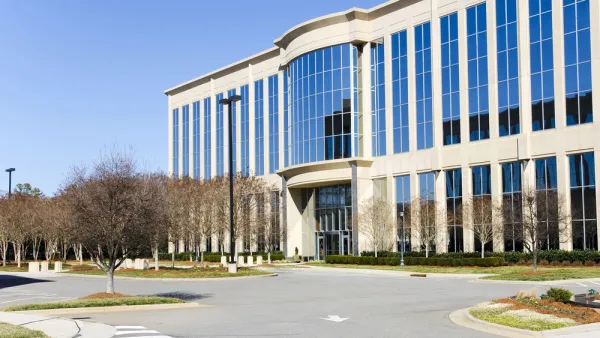
A Deep Dive into Suburban Retrofits
An interview with Ellen Dunham-Jones, co-author of "Retrofitting Suburbia," and Hazel Borys.

What an Innocuous Piece of Plastic Says About Our Suburban Future
Suburban Starbucks models are bumming urbanists out. But they also served as a nice allegory of what the future there might hold. Scott Doyon's latest blog post explains.
Ways to Fail at Form-Based Codes 04: Don’t Capture the Character
Form-based codes extract the DNA of the desired local character, and enable it by right. Hazel Borys talks about how to get the numbers right in this week's Back of the Envelope.

Planetizen Federal Action Tracker
A weekly monitor of how Trump’s orders and actions are impacting planners and planning in America.

California plans to bury El Niño’s downpour
If the state plays its cards right, it may be able to store a billion acre-feet of El Niño’s water in aquifers.

Desperate measures: Advocates weigh draining Lake Powell to fill Colorado River
Draining the reservoir could reduce evaporation losses by a couple hundred thousand acre-feet.

Mamdani’s pied-à-terre tax survives legal challenge
A panel of judges found that the plaintiffs failed to demonstrate injury as a result of New York City's implementation of the tax.

Eastern Nebraska is running out of electricity
Data centers and electrification are straining eastern Nebraska’s grid, throttling economic development.

Seattle passes record-breaking transit services expansion
Proposition 1 will double the city’s transit tax to add 95,000 more bus trips and preserve 180,000 bus trips annually.

FREE Course: Walkable City 1: Why Walkability?
After describing his path towards focusing on walkability as the essence of good planning, Jeff Speck marches through his five principal reasons for making more walkable places.
Reinventing Malls: Planning Alchemy—Turning Gray Fields Into Gold
The course focuses on the opportunities and imperatives that shape reinvention of mall sites.

City of Rosemead
Rutgers University, Edward J. Bloustein School of Planning and Public Policy
One Hundred Miles
University of Michigan School for Environment and Sustainability (SEAS)
Hunter College, City University of New York (CUNY)
The Architects Foundation
City of Cambridge
Montrose County
The Pocatello Development Authority