The long-awaited opening of the D.C. Streetcar on Feb. 27 brings time for reflection on Mayor Bill de Blasio's proposed $2.5 billion Brooklyn Queens Connector, part streetcar, part light rail. D.C.'s line took a decade of planning and construction.


"Washington’s experience serves as a cautionary tale, underlining the challenges even supporters say could complicate the de Blasio administration’s plans," writes Emma G. Fitzsimmons of The New York Times. "Asked about Washington’s troubles, Mayor Bill de Blasio, a Democrat, predicted a smoother path for New York."
Fitzsimmons goes into detail on the troubled past of the D.C. Streetcar, the operations that began on Feb. 27, and planned future extensions.
"Gabe Klein, a former district transportation director who inherited the streetcar project under the administration of Mayor Adrian Fenty, a Democrat who served from 2007 to 2011, said a major challenge had been that priorities shifted across four mayoral administrations and six transportation chiefs," writes Fitzsimmons. Klein went on to head Chicago's Department of Transportation.
“One of the biggest problems with the D.C. streetcar is the lack of continuity,” Mr. Klein said.
"His transportation commissioner, Polly Trottenberg, said that she had spoken with officials in Washington and that New York would learn from their mistakes," writes Fitzsimmons.
Ms. Trottenberg recently told reporters that one lesson from Washington is the city must carefully consider preliminary decisions for the streetcar, because it would have to live with them for a long time. The project will need a sound organizational structure, she said, and the city is considering creating a local development corporation to oversee the plans.
Calling the boom in streetcars “a national and a worldwide phenomenon,” Ms. Trottenberg named the system in Portland, Ore. [touted in a 2011 NPR article] and France’s many lines as examples of successful models that New York would examine.
"France is not alone in using trams, of course; Germany, notably, has dozens of such systems across the country, as do Switzerland, the Netherlands, and others," wrote Yonah Freemark in The Transport Politic in 2012. "But as of late, France’s cities have made an unparalleled investment in the mode."
Not all local governments stick with streetcar plans. Arlington County, Virginia dropped a plan that had been under consideration for 15 years, to the disappointment of Fairfax County. The New York Times goes into detail about the surprise decision to drop the plan, as well as other streetcar disappointments, as does NPR.
Another notable streetcar that didn't leave the drawing board was in San Antonio, Texas, though it appeared political forces got the best of it.
Before Mayor de Blasio proposed the BQX, his predecessor, Michael Bloomberg, was interested in pursuing a Red Hook, Brooklyn to downtown Brooklyn streetcar. See 2010 press release and feasibility study [PDX].
FULL STORY: Washington Streetcar Stumbles Could Benefit de Blasio’s Plan

More Details of Brooklyn-to-Queens Streetcar Proposal Emerge
One interesting detail to note: the BQX streetcar proposal, as its currently known, originated not from the de Blasio Administration but from a Brooklyn-based real estate company.
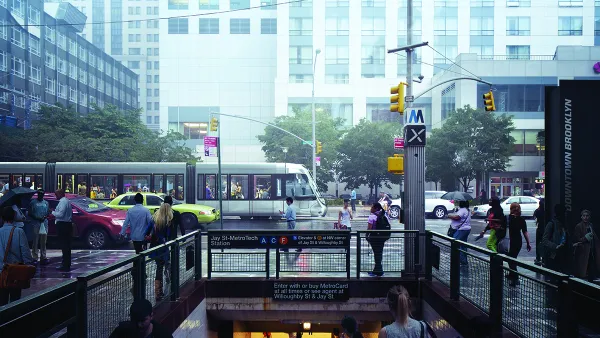
Brooklyn-Queens Connector Streetcar Plans Released
Plans for the Brooklyn-Queens Connector, otherwise known as the BQX, are still on the table, despite reports of the project's demise.
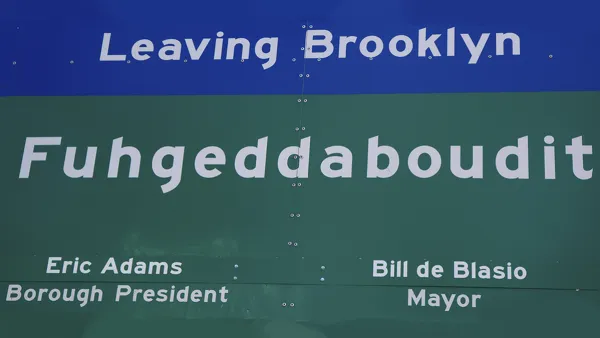
MIA or DOA? The Brooklyn-Queens Streetcar Fading Fast
The lack of news on the proposed Brooklyn Queens Connector (BQX) is hardly a death knell, but that doesn't mean no news is good news, either.

Planetizen Federal Action Tracker
A weekly monitor of how Trump’s orders and actions are impacting planners and planning in America.

The state-sanctioned urbicide of Austin
People don’t kill cities. Freeways do.

US to reduce Colorado River water deliveries to Mexico
A new Colorado Treaty amendment reduces Mexico’s Colorado River water allocation by 250,000 acre feet.

5 New England states march closer to 800 megawatt wind energy project
Securing federal approval for the project may be complicated under the Trump administration, which has historically been hostile towards domestic wind power.

Baltimore to break ground on $50 million Transit Priority Project
The project will bring faster bus trips, safer streets and better bike connections to Baltimore.

Airbnb launches $250 million 'last-dollar financing' housing accelerator, makes first investment in Austin
The company will put $6.4 million towards affordable housing development in Texas’ capital.

FREE Course: Walkable City 1: Why Walkability?
After describing his path towards focusing on walkability as the essence of good planning, Jeff Speck marches through his five principal reasons for making more walkable places.
Reinventing Malls: Planning Alchemy—Turning Gray Fields Into Gold
The course focuses on the opportunities and imperatives that shape reinvention of mall sites.

Eagle County Government
Harvard University Graduate School of Design
Nashville Planning Department
The Architects Foundation
University of Cincinnati Online
The Pocatello Development Authority
The Urban Renewal Agency of the City of Pocatello
Journal of the American Planning Association