Yes, this is the real deal. After years of delay and planning and construction mishaps, the long-awaited $200 million, 2.2 mile line streetcar line down H Street began service Saturday. Not all media were kind to the streetcar, even on opening day.


Adam Tuss, transportation reporter for NBC Washington, reports from H Street on the opening ceremony of the long-awaited, $200 million streetcar line.
Mayor Muriel Bowser kicked things off at 10 a.m. with a ceremony at 13th and H streets NE. Regular service began after the speeches
Tuss took a test drive on Friday—but he warns riders to expect delays due to congestion and collisions by motor vehicles, even if not with the streetcar.
"Car crashes needed to be cleared from the path twice during a test ride News4's Adam Tuss took Friday," notes the NBC report.
Initially the streetcar service will be free, but don't expect to catch the streetcar on Sundays—no service, according to Washington Post's FAQ. Expect "average speeds (of) 10 to 15 mph, according to the streetcar’s operations manager," writes Dr. Gridlock. Information is also available on the DC Streetcar website.
The Economist didn't join in the celebratory mood. Their Gulliver Business travel blog piece describes the "catastrophic execution" of the streetcar project. No surprise considering the magazine's 2014 piece on the streetcar titled "Rolling Blunder." Planetizen also chronicled the troubled history of the project, but not today.
Free rides for the first six months. "DDOT will announce the permanent fare policy at the end of the free service period," notes their webpage.
Read the full story: All Aboard! DC Streetcar Service Starts Saturday
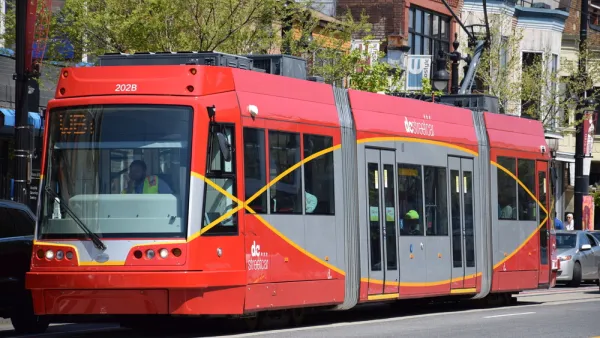
A Sneak Peak at D.C.'s Streetcar Extension Plans
With the controversy about the value of its newly opened streetcar ongoing, Washington, D.C. has commenced with a planning process for extending the line to Georgetown.
Report: Construction, Management Problems Plague the D.C. Streetcar
The long-delayed D.C. Streetcar got some very bad news last week, when a panel of industry experts found evidence of construction mistakes that will severely impact the system's reliability.
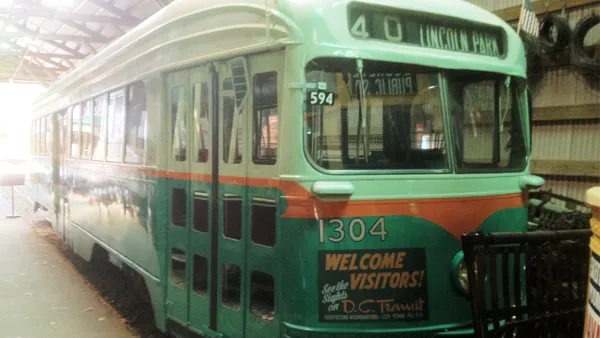
D.C. Officials Dramatically Scale Back Streetcar System
In a recent move, officials from Mayor Vincent C. Gray's administration shortened DC's streetcar system to a much-shorter eight miles.

Planetizen Federal Action Tracker
A weekly monitor of how Trump’s orders and actions are impacting planners and planning in America.

California plans to bury El Niño’s downpour
If the state plays its cards right, it may be able to store a billion acre-feet of El Niño’s water in aquifers.

Desperate measures: Advocates weigh draining Lake Powell to fill Colorado River
Draining the reservoir could reduce evaporation losses by a couple hundred thousand acre-feet.

In Texas, data centers are swallowing promised parkland
Residents who moved to Taylor, Texas for a rural community now have to contend with three data centers in their backyard.

How a Chicago-sized wind farm beat the odds and powered on
The project spanned five presidential administrations and a standoff with a U.S. military base.

MTA gives itself 30 days to transform pit into basketball court
The site has been under construction since 2022; the city originally estimated it would finish the court in 2024.

FREE Course: Walkable City 1: Why Walkability?
After describing his path towards focusing on walkability as the essence of good planning, Jeff Speck marches through his five principal reasons for making more walkable places.
Reinventing Malls: Planning Alchemy—Turning Gray Fields Into Gold
The course focuses on the opportunities and imperatives that shape reinvention of mall sites.

City of Rosemead
Rutgers University, Edward J. Bloustein School of Planning and Public Policy
One Hundred Miles
Hunter College, City University of New York (CUNY)
The Architects Foundation
University of Cincinnati Online
City of Cambridge
Montrose County
The Pocatello Development Authority