New research says land use patterns have increased the costs of wildfire protection, so strategic land use planning would help lower the costs of wildfire protection.


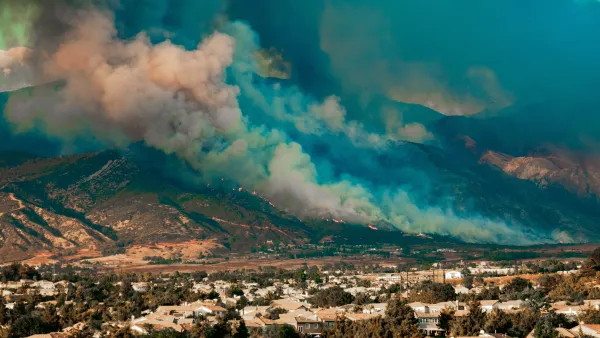
"Building houses far apart and in locales beyond town -- the wildland-urban interface -- increases firefighting costs in the Rocky Mountain West, according to a new report from the Open Spaces Initiative at the University of Wyoming."
The news comes via the University of Wyoming website, which also notes that the study's authors argue for strategic land-use planning to "reduce wildfire suppression costs by increasing firefighting efficiency." Moreover, the "dramatic rise in firefighting costs over the last decade is due, in part, to the growth of residential development in the wildland-urban interface"—otherwise known as poor land use planning.
The efficiency of firefighting efforts falls precipitously as homes get farther apart in wildland areas. According to the study. "Using data from 291 wildfires in Colorado, Montana and Wyoming from 2002-2011, researchers found a single isolated home can add $225,000 to overall firefighting costs, while a home within a dense cluster can contribute as little as $100."
Hat tip to Shane Phillips for sharing the post.
Read the full story: New Report Suggests Strategic Land-Use Planning Can Increase Firefighting Efficiency

Nearly a third of US housing is in the wildland-urban interface — and at growing risk of wildfire
As suburbs increasingly mingle with undeveloped land, homes face a higher risk from destructive fires.
Home Insurers Are Fleeing California
Homeowners in the state are finding it increasingly difficult to secure insurance policies thanks to the growing risks of wildfire, drought, and other climate threats.
Between a Rock and a Hard Place: Housing and Fire Safety in California
A proposed development near the site of the devastating Camp Fire highlights the growing tension between building badly needed housing and protecting communities from heightened wildfire risk.

Planetizen Federal Action Tracker
A weekly monitor of how Trump’s orders and actions are impacting planners and planning in America.

California plans to bury El Niño’s downpour
If the state plays its cards right, it may be able to store a billion acre-feet of El Niño’s water in aquifers.

Desperate measures: Advocates weigh draining Lake Powell to fill Colorado River
Draining the reservoir could reduce evaporation losses by a couple hundred thousand acre-feet.

Mamdani’s pied-à-terre tax survives legal challenge
A panel of judges found that the plaintiffs failed to demonstrate injury as a result of New York City's implementation of the tax.

Eastern Nebraska is running out of electricity
Data centers and electrification are straining eastern Nebraska’s grid, throttling economic development.

Seattle passes record-breaking transit services expansion
Proposition 1 will double the city’s transit tax to add 95,000 more bus trips and preserve 180,000 bus trips annually.

FREE Course: Walkable City 1: Why Walkability?
After describing his path towards focusing on walkability as the essence of good planning, Jeff Speck marches through his five principal reasons for making more walkable places.
Reinventing Malls: Planning Alchemy—Turning Gray Fields Into Gold
The course focuses on the opportunities and imperatives that shape reinvention of mall sites.

City of Rosemead
Rutgers University, Edward J. Bloustein School of Planning and Public Policy
One Hundred Miles
University of Michigan School for Environment and Sustainability (SEAS)
Hunter College, City University of New York (CUNY)
The Architects Foundation
City of Cambridge
Montrose County
The Pocatello Development Authority