A new study quantifies the amount of space devoted to parking in Los Angeles County—a figure that just begs to be visualized.


A recently released study in the Journal of the American Planning Association did an inventory on parking spaces in Los Angeles County—tracking the proliferation of parking across the county between 1900 and 2010. The big headline of the post: 14 percent of incorporated land in Los Angeles County is committed to parking. A stand-alone website for the study provides an abstract, of sorts, for the study, showing heat maps of parking (residential offstreet, non-residential offstreet, and total) around the county at 20 year intervals beginning with 1950.
Blogger Shane Phillips followed on the study to coalesce the data provided by the study into a nifty infographic that drives the point home a little more clearly. Phillips images all of that parking as one large parking crater—16 miles in diameter and taking up an area spanning East L.A. to Santa Monica. In real life, the area inside that parking crater fits 2.3 million residents, 900,000 homes, and 1 million workers, according to Phillips's calculations.
Read the full story: Mapped: All 200 Square Miles of Parking in LA County, As One Giant Parking Lot

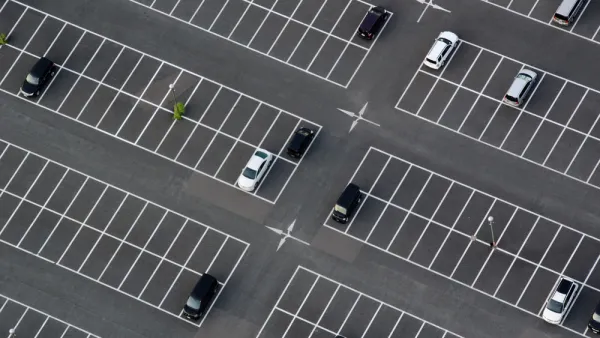
How Cities Are Slimming Down on Parking
Cities around the world are finding ways to go on a parking diet, freeing up unused space. San Francisco and Philadelphia are two U.S. leaders, while cities like Paris, Copenhagen, and Zurich pursue even more aggressive measures.
Unlocking the Curb Conundrum: How to Solve Our Parking Crisis
For Alan Durning, curb-parking territoriality is the root cause of many of America's urban ills, from housing affordability to economic vitality. He describes the circumstances that've led to the current state of affairs and introduces the way out.
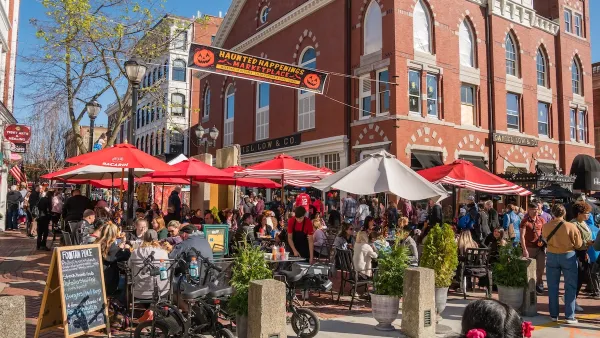
Salem, Massachusetts Eliminates Parking Minimums
An analysis found that the city’s real parking demand is around 0.85 spots per housing unit, far less than the 1.5 spaces required under the old zoning code.

Planetizen Federal Action Tracker
A weekly monitor of how Trump’s orders and actions are impacting planners and planning in America.

The state-sanctioned urbicide of Austin
People don’t kill cities. Freeways do.

US to reduce Colorado River water deliveries to Mexico
A new Colorado Treaty amendment reduces Mexico’s Colorado River water allocation by 250,000 acre feet.

Nation's most wind-powered state turns to coal as data centers increase energy demand
For the first time in decades, Iowa has increased its generation of coal power.

NYC cools commuters with city's first rain garden above a bus stop
New York City officials say the plants in the rain garden can absorb 16 gallons of rainwater during heavy storms.

Brightline West’s future may rely on $6 billion federal loan
The company has until Nov. 2 to make a $400 million equity investment into its proposed high-speed rail line.

FREE Course: Walkable City 1: Why Walkability?
After describing his path towards focusing on walkability as the essence of good planning, Jeff Speck marches through his five principal reasons for making more walkable places.
Reinventing Malls: Planning Alchemy—Turning Gray Fields Into Gold
The course focuses on the opportunities and imperatives that shape reinvention of mall sites.

Eagle County Government
Harvard University Graduate School of Design
Nashville Planning Department
The Architects Foundation
University of Cincinnati Online
The Pocatello Development Authority
The Urban Renewal Agency of the City of Pocatello
Journal of the American Planning Association