The spread of craft beer manufacturing around the United States has followed demographic patterns, along with friendly regulations.


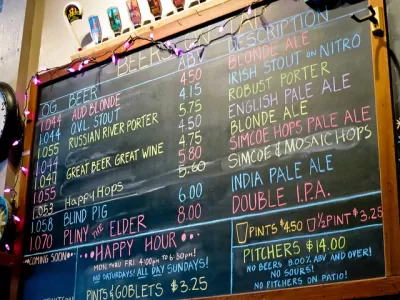
A newly released paper [pdf] in the Journal of Wine Economics documents the spread of craft beer production across the United States, reports Alison Griswold. The study sheds light on the other side of the equation in the booming popularity of craft beer—not which beers people are buying and where, but where the craft beers are crafted, as it were.
Griswold summarizes the narrative presented in the paper:
"Back in the 1980s, the vast majority of craft breweries were located in the Pacific Northwest—California, Washington, and Oregon. Over the next decade, production moved to the Northeast, and then slowly came back to fill out states in the Midwest. It took until 2001 for every state to be making craft beer, with southern states generally taking longest to enter the market."
The paper's researcher's boil down the causes for that geographic pattern to four main factors. According to Griswold, "[t]he first three are demographic: Craft breweries tend to set up in states with higher incomes, a denser population, and a greater number of young adults." The fourth factor is regulation, which varies widely between states and even cities.
Read the full story: These maps show how craft beer production spread across the US


Developer Aims to Fill a 'Craft Beer Desert' in Austin
Yeah, they went there.
Which Cities Have the Most Breweries Per Capita
A new study reveals with cities have the most beer to go around.
Op-Ed: Don't Ditch Those Industrial Land Uses
An op-ed describes the choice by many cities to prioritize residential projects in old industrial spaces as short-sighted and potentially unjust.

Planetizen Federal Action Tracker
A weekly monitor of how Trump’s orders and actions are impacting planners and planning in America.

Amtrak, CN end decades-long dispute with eight-year agreement
The new operating agreement establishes an updated framework for the companies to work together, including processes to resolve disputes.

Judges permit Denver to divert 77,000 acre feet from the Colorado River for reservoir expansion
Overuse and climate change have caused the Colorado River’s water levels to plummet.

NYC DOT wants faster, more permanent street upgrades
The city is examining ways to build more concrete infrastructure without getting entangled in 'decades-long' projects.

'Something we’ve never seen before:' rising utility rates could strain city finances nationwide
Data centers, climate change and other factors have caused utility rates in the United States to increase by 38% since 2020.

Trump to overrule local leaders, lease millions of acres of America’s Pacific Island territories’ seafloors to mining companies
International law says that the Indigenous people of America’s territories have a right to prior and informed consent regarding projects that impact their countries.

FREE Course: Walkable City 1: Why Walkability?
After describing his path towards focusing on walkability as the essence of good planning, Jeff Speck marches through his five principal reasons for making more walkable places.
Reinventing Malls: Planning Alchemy—Turning Gray Fields Into Gold
The course focuses on the opportunities and imperatives that shape reinvention of mall sites.

Harvard University Graduate School of Design
KFH Group Inc.
Greater Baltimore Committee
The Architects Foundation
University of Cincinnati Online
The Pocatello Development Authority
The Urban Renewal Agency of the City of Pocatello