To alleviate tourist traffic and serve residents, the Regional Transportation Commission of Southern Nevada has unveiled a long-term plan to invest billions in transit improvements including light rail and an expanded monorail.


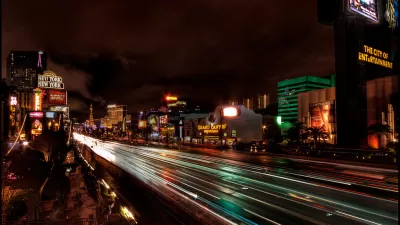
Prompted by clogged traffic on the Las Vegas Strip and a desire to keep pace with transit-invested peer cities, "the 30-year transit plan released by the Regional Transportation Commission proposes light rail in the resort corridor, an expanded monorail that would connect the major convention centers and various roadway improvements, among other projects," according to an article by J.D. Morris.
Morris writes, "The goal is to prevent the Las Vegas area's roadways from becoming overwhelmed by the anticipated growth in visitation and resident population in future years [...] Currently envisioned to connect the Strip, downtown and the airport, light rail could cost from $2.1 billion to $12.5 billion. Jeremy Aguero of Applied Analysis said the costs vary widely depending on whether the system would be built at, above or below street level."
Despite questions around funding, the long-term investment might pay off. From the article: "the transit proposals would have a projected total economic impact of $56 billion to $178 billion, and they could create as many as 122,000 jobs, according to the commission."
Read the full story: RTC unveils long-ranging transportation plan that includes light rail
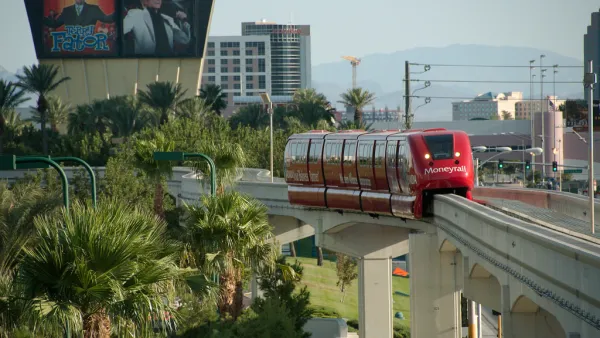
Las Vegas Light Rail Plans Take a Big Step Forward
The Regional Transportation Commission of Southern Nevada has proven its seriousness about an ambitious proposal to build a light rail connection between McCarran International Airport and the Las Vegas Strip.
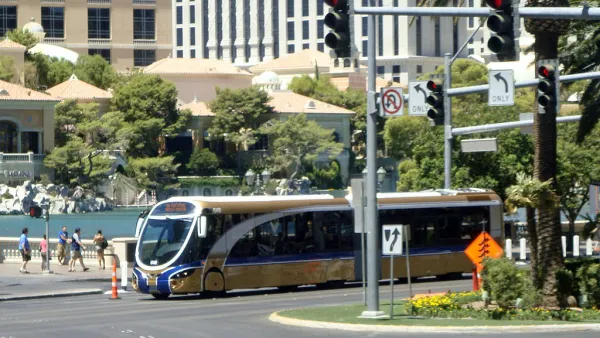
Bus Transit Used to Be Profitable on the Las Vegas Strip
The Regional Transportation Commission is looking for ways to reverse ridership figures that have plummeted since the advent of transportation network companies.
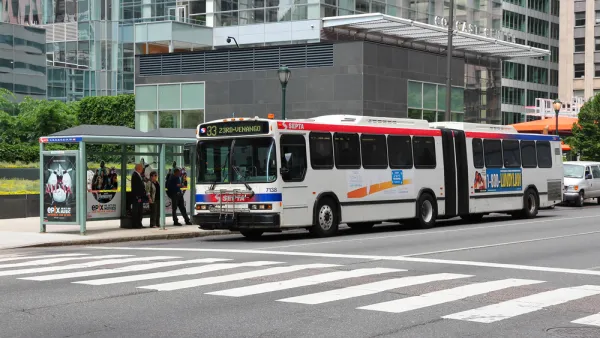
Calculating Bus Stop Spacing for 43 U.S. Cities
New research documents the distance between bus stops in U.S. cities—a key question for service designers that determines a lot about the public transit user experience.

Desperate measures: Advocates weigh draining Lake Powell to fill Colorado River
Draining the reservoir could reduce evaporation losses by a couple hundred thousand acre-feet.

Eastern Nebraska is running out of electricity
Data centers and electrification are straining eastern Nebraska’s grid, throttling economic development.

Malls are becoming the midtowns of the future
Mall and office park redevelopments are a generational opportunity to create new nodes of urbanity.

NYC breaks ground on anti-flooding infrastructure project
New York City's new system will reduce stormwater flows to local sewers by 90%.

One Kentucky town’s secret to affordable housing
The Smoketown Community Land Trust has already built seven affordable homes for community members.

Houston gains petal-shaped cooling infrastructure to make streets more ‘delightful’
The city has installed the pavilions along 15 blocks in Houston.

FREE Course: Walkable City 1: Why Walkability?
After describing his path towards focusing on walkability as the essence of good planning, Jeff Speck marches through his five principal reasons for making more walkable places.
Reinventing Malls: Planning Alchemy—Turning Gray Fields Into Gold
The course focuses on the opportunities and imperatives that shape reinvention of mall sites.

City of Rosemead
Rutgers University, Edward J. Bloustein School of Planning and Public Policy
One Hundred Miles
University of Michigan School for Environment and Sustainability (SEAS)
Hunter College, City University of New York (CUNY)
The Architects Foundation
City of Cambridge
Montrose County
The Pocatello Development Authority