Journalist Alex Ulam speaks with Sarene Marshall, director of the Urban Land Institute's Center for Sustainability, about the role conservation is playing in fighting climate change and her role at the agency.


What was it like moving from The Nature Conservancy to the Urban Land Institute? They seem like very different organizations. For one thing, one focuses on wild areas and the other focuses on settled areas.
When I worked at The Nature Conservancy, a dramatic transformation was taking place in conservation everywhere. We were shifting from this older notion of parks and protected areas, places that we put fences around and kept people out of, to one where people are going to be part of conservation landscapes.
Increasingly, there are fewer and fewer places in the world that you can imagine being completely pristine. So at The Nature Conservancy our work changed significantly, from being wholly focused on protecting wild places to also working on conservation issues involving land that was ranched or farmed or timbered. We were also engaging urban populations about where their water and food is coming from.
Read the full story: A conservationist turns to the city

Could the Humble Heat Pump Be a Decarbonization Hero?
Buildings are responsible for a little less than half of greenhouse gas emissions in the U.S. Break this figure down further and you'll find that building heating accounts for about a fifth of all U.S. emissions.
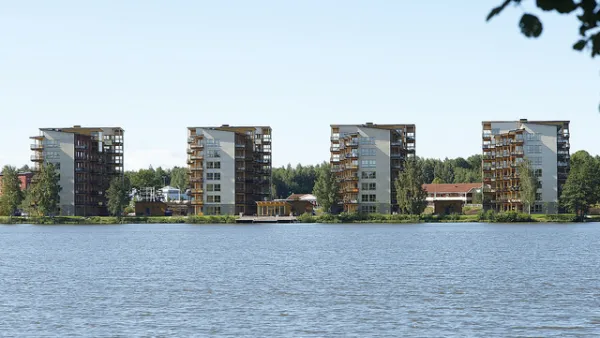
Fire Tests Enable New Timber Typologies
After a long time lost in the woods, architects and engineers are rediscovering timber. Recent fire tests have demonstrated that timber can be a viable building material and meet existing code requirements.
Can Insurance Markets Jump-Start Resilience?
Risk-management experts are seeking creative ways to finance resilience investments that prevent damage from natural disasters. Insurance markets, with their direct stake in protecting homes and businesses, can be key partners in this effort.

Planetizen Federal Action Tracker
A weekly monitor of how Trump’s orders and actions are impacting planners and planning in America.

Amtrak, CN end decades-long dispute with eight-year agreement
The new operating agreement establishes an updated framework for the companies to work together, including processes to resolve disputes.

Judges permit Denver to divert 77,000 acre feet from the Colorado River for reservoir expansion
Overuse and climate change have caused the Colorado River’s water levels to plummet.

Boston has spent millions making the Green Line more accessible — and there’s no end in sight
While the city has invested millions into expanding and adding platforms to the Green Line to make it more accessible, new train cars set to arrive next year will be too tall for disabled passengers to board without raising the current platforms.

Idaho may see an 18% drop in federal surface transit funding — the largest estimated cut in the US
Transit systems in rural communities are much more reliant on federal funding to provide their services.

How ‘post-disaster gentrification’ alters neighborhoods after natural calamities
After hurricanes, fires or other calamities, the original residents of a community are often replaced by younger, wealthier residents.

FREE Course: Walkable City 1: Why Walkability?
After describing his path towards focusing on walkability as the essence of good planning, Jeff Speck marches through his five principal reasons for making more walkable places.
Reinventing Malls: Planning Alchemy—Turning Gray Fields Into Gold
The course focuses on the opportunities and imperatives that shape reinvention of mall sites.

City of Wisconsin Rapids
Harvard University Graduate School of Design
KFH Group Inc.
The Architects Foundation
University of Cincinnati Online
The Pocatello Development Authority
The Urban Renewal Agency of the City of Pocatello