Seattle political leadership recently announced an ambitious plan to build more sidewalks with less money.


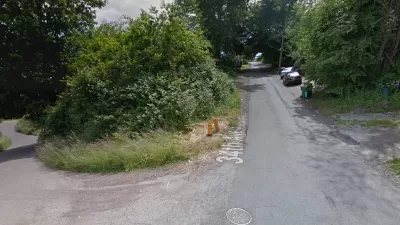
[Updated 11/3/2015] Stephen Fesler reports on a plan announced recently by Seattle Mayor Ed Murray construct at least 250 blocks of new sidewalks over the next nine years and "to give more Seattleites more options when it comes to getting around on foot..."
Central to the proposal is a concern for lowering the cost of pedestrian facilities. According to Fesler, "[The mayor's] plan would implement more cost-effective techniques in sidewalk materials and designs. In fact, some 'sidewalks' might not even be what we consider as a traditional sidewalk. Murray is also proposing the development of new tools for and partnerships with private individuals to construct walking facilities." The mayor's proposal would aim to construct the 250 blocks of new sidewalks at the cost of 150 blocks of concrete sidewalks constructed in the traditional model.
A press release from the Mayor's Office reveals more about how and where the city would undertake the new sidewalk construction program.
The scale of the proposal also hinges on the Move Seattle, which is up for vote today. Fesler reported in August about Seattle's disconnected network of sidewalks, a legacy of the city's history of incorporation.
This post was updated from miles to blocks to represent the accurate distance measured.
Read the full story: SEATTLE MAYOR ED MURRAY REVEALS LOW-COST SIDEWALK PROGRAM


Seattle's New Updated Pedestrian Master Plan Includes $22 Million for Sidewalks
The promised update for the city of Seattle's Pedestrian Master Plan was released to the public last week.
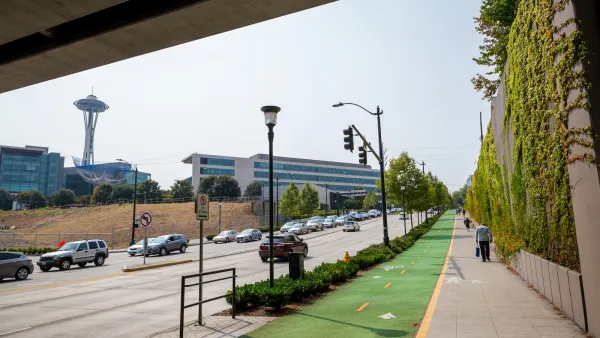
Seattle's transportation levy had a fruitful first year
The city repaired over 17,000 potholes, completed close to 21,000 sidewalk projects, and planted over 1,100 trees with revenue from an eight-year levy approved by voters in 2024.
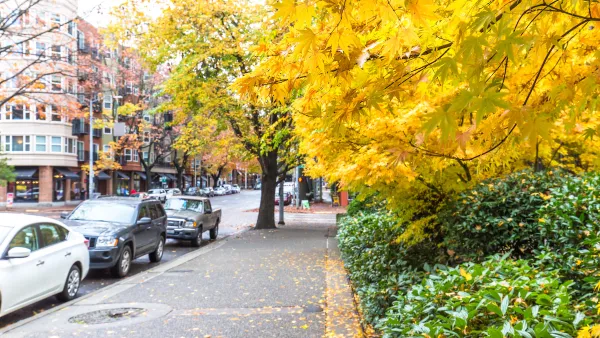
Proposal Could Mandate Sidewalks as Part of Seattle Complete Streets
Almost a third of the city’s neighborhood streets lack sidewalks.

Planetizen Federal Action Tracker
A weekly monitor of how Trump’s orders and actions are impacting planners and planning in America.

Amtrak, CN end decades-long dispute with eight-year agreement
The new operating agreement establishes an updated framework for the companies to work together, including processes to resolve disputes.

Judges permit Denver to divert 77,000 acre feet from the Colorado River for reservoir expansion
Overuse and climate change have caused the Colorado River’s water levels to plummet.

NYC DOT wants faster, more permanent street upgrades
The city is examining ways to build more concrete infrastructure without getting entangled in 'decades-long' projects.

'Something we’ve never seen before:' rising utility rates could strain city finances nationwide
Data centers, climate change and other factors have caused utility rates in the United States to increase by 38% since 2020.

Trump to overrule local leaders, lease millions of acres of America’s Pacific Island territories’ seafloors to mining companies
International law says that the Indigenous people of America’s territories have a right to prior and informed consent regarding projects that impact their countries.

FREE Course: Walkable City 1: Why Walkability?
After describing his path towards focusing on walkability as the essence of good planning, Jeff Speck marches through his five principal reasons for making more walkable places.
Reinventing Malls: Planning Alchemy—Turning Gray Fields Into Gold
The course focuses on the opportunities and imperatives that shape reinvention of mall sites.

Harvard University Graduate School of Design
KFH Group Inc.
Greater Baltimore Committee
The Architects Foundation
University of Cincinnati Online
The Pocatello Development Authority
The Urban Renewal Agency of the City of Pocatello