The Bay Area is one of the few metro regions in the U.S. with a separate MPO and COG, but that could change after voting members of both the Metropolitan Transportation Commission and the Association of Bay Area Governments agreed to a merger study.


"Leaders of the Association of Bay Area Governments (ABAG) at an early morning meeting agreed to study merging with the Metropolitan Transportation Commission (MTC), a proposal they had initially opposed," writes Andrew McGall of the Bay Area News Group.
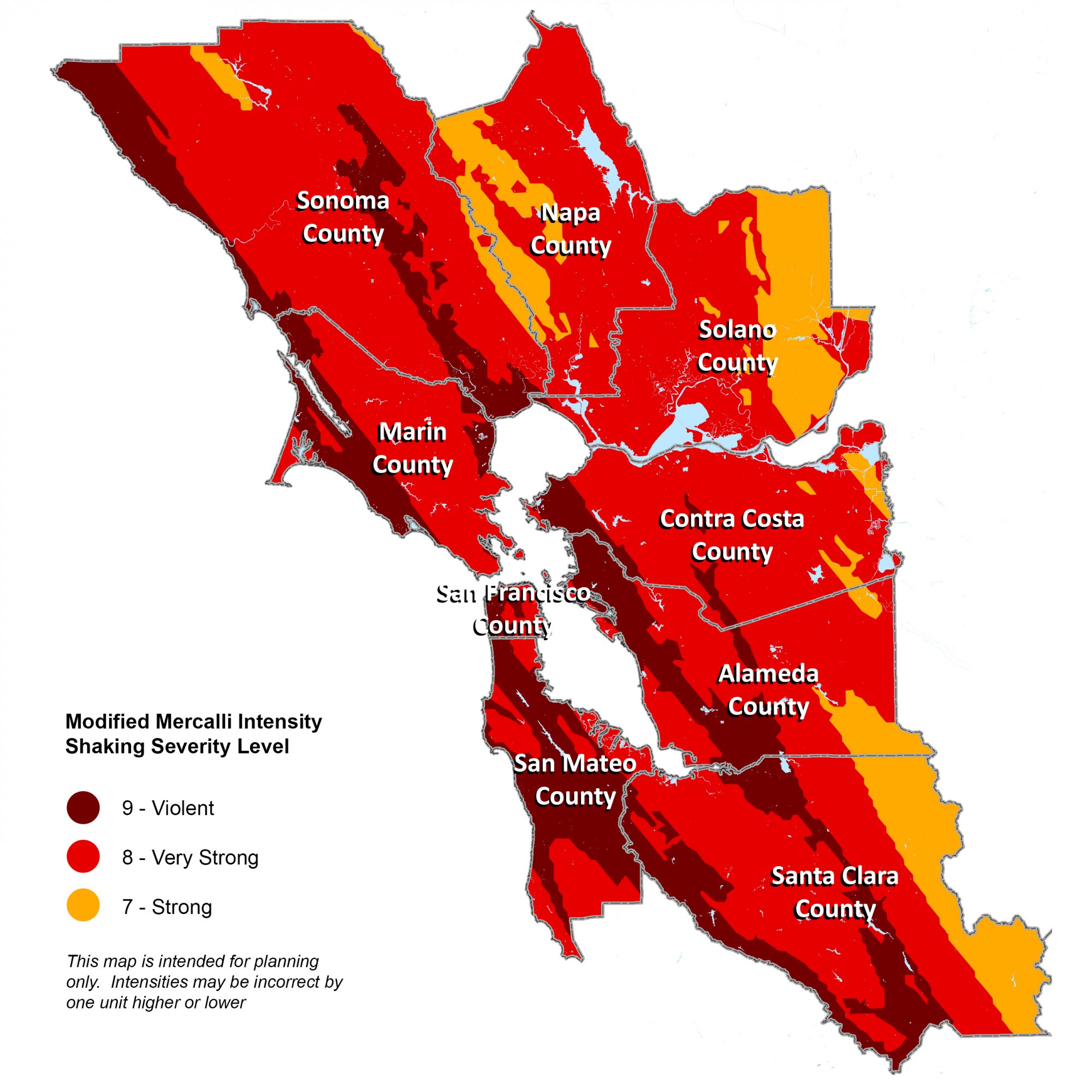 Source: USGS 2013 via ABAG
ABAG is the region's coalition of governments (COG) that deals with housing allocations and other planning (including earthquake preparation as illustrated above) while MTC is the metropolitan planning organization (MPO) that "is the transportation planning, coordinating and financing agency for the nine-county San Francisco Bay Area," according to its webpage.
Later in the morning, the commission's board tossed aside its plan for a unilateral takeover of ABAG's planning staff. Instead, it unanimously approved working with the association to complete a merger plan by June 1.
"The two agencies are vastly different in size and scale, with the MTC’s budget of $945 million dwarfing ABAG’s budget of $27 million," notes The Daily Journal.
What's more, ABAG gets its funding from MTC, notes MTC Executive Director Steve Heminger in an earlier, comprehensive Contra Costa Times column comparing the functions of the two agencies and explaining why Bay Area residents should be interested in the proposed merger.
The support for ABAG from cities comes as a surprise considering the agency is disliked by many because of its role it plays in assigning regional housing need allocations.
"These are unelected people who have this personal vision of what is good for everybody else," Corte Madera Councilman Michael Lappert said of ABAG before voting to withdraw from the agency. "They have no check, no balance." [Marin Independent Journal, 03/07/12]
In an opinion (posted here) for the San Jose Mercury News, Egon Terplan, Regional Planning Director for SPUR, writes, "In recent decades, there have been numerous attempts to merge ABAG and MTC. None has succeeded."
Déjà vu?
To understand the historical basis for the split and some of those past attempts, see chapter 2: "Origins And Evolution Of COGs And MPOs—And Their Split In The Bay Area" of a Public Policy Institute of California "occasional paper": "Considerations Regarding the Possible Merger of the Association of Bay Area Governments and the Metropolitan Transportation Commission Reform" (pdf), dated October 30, 2001.
A San Francisco editorial posted here last year suggests going further - merging not two but three regional planning agencies, and that regional planning evolve into regional governance like the Portland region's Metro.
Hat tip appropriately goes to the MTC-ABAG Library.
FULL STORY: Bay Area regional planning agencies to merge


Can a Single Regional Planning Agency Fix What Ails the Bay Area?
The potential to address the housing and transportation issues of the Bay Area by a single regional agency will be addressed this week.
Plan Bay Area: Sued From the Right, Now the Left
Plan Bay Area must be doing something right as it seems to be antagonizing those on both ends of the planning spectrum. First, a libertarian group sues because of "densification", and now environmentalists sue because not enough funds go for transit.
One Major Flaw of Plan Bay Area
According to SF State University geographer, Jason Henderson, the adoption of Plan Bay Area by MTC and ABAG last Thursday was a "watershed moment in regional planning", but it also was a missed opportunity to improve transit to capture more trips.

The state-sanctioned urbicide of Austin
People don’t kill cities. Freeways do.

US to reduce Colorado River water deliveries to Mexico
A new Colorado Treaty amendment reduces Mexico’s Colorado River water allocation by 250,000 acre feet.

New Jersey’s second-largest city bans standalone data centers
Jersey City will continue to allow co-location facilities, such as those meant for research institutions that store their own data.

Amtrak not solely to blame for New Jersey commuter rail's unreliability, report finds
A new study from the Garden State Initiative found that NJ Transit’s budget grew 20% across a 4 year period, but reliability declined significantly over the same period.

EPA erases limits on planet-warming pollution from power plants
Under Monday’s plan, power plants would still have some limits on how much mercury, arsenic and other contaminants they can emit.

Phoenix announces new on-demand transit service, more frequent RAPID buses
Both new services will launch in October, and are part of Phoenix's Project Effective Access Solutions for Easing Congestion.

FREE Course: Walkable City 1: Why Walkability?
After describing his path towards focusing on walkability as the essence of good planning, Jeff Speck marches through his five principal reasons for making more walkable places.
Reinventing Malls: Planning Alchemy—Turning Gray Fields Into Gold
The course focuses on the opportunities and imperatives that shape reinvention of mall sites.

Eagle County Government
Harvard University Graduate School of Design
Nashville Planning Department
The Architects Foundation
University of Cincinnati Online
The Pocatello Development Authority
The Urban Renewal Agency of the City of Pocatello
Journal of the American Planning Association