Something needs to change if Arizona is going to be able to pay the bills for maintaining and building new roads, according to the findings of an audit by the state.


"Motorists may need to pay more at the pump, on the roads or at the cash register to meet the funding needs of the Arizona Department of Transportation through 2035, according to a recent state audit," reports Curtis Spicer.
"The Office of the Auditor General released an audit earlier this week [pdf] that projects a $62.7 billion shortfall through fiscal year 2035 if the state Legislature doesn’t pass new directives."
The audit also recommends several possible policy changes that could help the state make up the deficit. All of those options, save one, involve generating new sources of revenue. The exception would raid the state's general fund.
State Rep. Karen Fann, a Republican and member of the House Transportation Committee, is even on the record in the article saying, "the major problem we have with voters in our state is that they are predominantly for no new taxes."
Read the full story: Audit says ADOT faces budget shortfall of $62.7 billion and needs solutions

Arizona to Build ‘Testbed’ for Autonomous Vehicles
The Arizona Department of Transportation announced a public-private partnership to install fiber-optic infrastructure along 405 miles of interstate highways to enable vehicle connectivity.
Transit Faces a Fiscal Cliff in New York City—Sooner Than Expected
It's like March 2020 all over again.
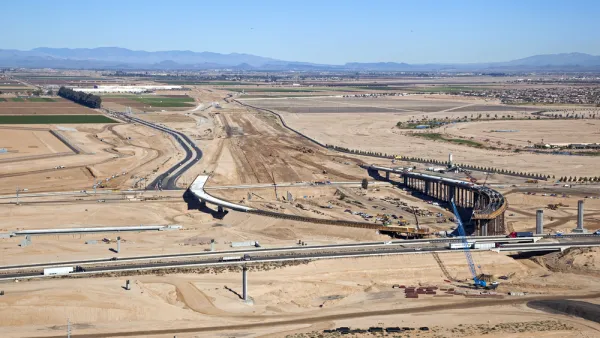
Massive Widening Planned for Interstate 10 in Maricopa County
The Arizona Department of Transportation has selected a developer for the Broadway Curve Improvement Project, which would widen Interstate 10, spanning multiple jurisdictions adjacent to Phoenix.

Planetizen Federal Action Tracker
A weekly monitor of how Trump’s orders and actions are impacting planners and planning in America.

Eastern Nebraska is running out of electricity
Data centers and electrification are straining eastern Nebraska’s grid, throttling economic development.

Move over, LA: St. Louis gears up for Olympics, invests millions in downtown redevelopment
The Missouri city will host the 2028 Olympic soccer group stage and knockout matches.

Dallas releases zoning code overhaul to officials
The drafted overhaul is over 400 pages long.

NYC renovations for dangerous, ‘mercilessly crammed’ street delayed until 2027
Construction was supposed to begin this fall.

San Diego’s Midway Rising project gets greenlight from city council
The project looks to become the largest affordable housing development in California's history.

FREE Course: Walkable City 1: Why Walkability?
After describing his path towards focusing on walkability as the essence of good planning, Jeff Speck marches through his five principal reasons for making more walkable places.
Reinventing Malls: Planning Alchemy—Turning Gray Fields Into Gold
The course focuses on the opportunities and imperatives that shape reinvention of mall sites.

City of Rosemead
Rutgers University, Edward J. Bloustein School of Planning and Public Policy
One Hundred Miles
University of Michigan School for Environment and Sustainability (SEAS)
Hunter College, City University of New York (CUNY)
The Architects Foundation
City of Cambridge
The Pocatello Development Authority
The Urban Renewal Agency of the City of Pocatello