Missouri's inability to pass transportation funding legislation or ballot measures has come home to roost in the growing number of bridges classified in "critical condition"—just one or two steps from being closed, according to MoDOT.


While the media has been gloating about the lowest gas prices for a Labor Day weekend in 11 years, the Missouri Department of Transportation (MoDOT) reminds us that there may be consequences to cheap gas, particularly for states that have failed to increase gas taxes or provide other means of critical infrastructure funding.
MoDOT "has long been warning that state transportation revenues are not enough for MoDOT to keep existing infrastructure in current condition," writes AASHTO Journal. The number of state bridges "in critical need of attention has risen to 641 this summer from 591 a year ago. Missouri has 10,376 bridges on state highways."
While "still safe to drive over, MoDOT said such "critical condition bridges are the state's worst, and with continued deterioration are just one or two steps from being closed."
State Bridge Engineer Dennis Heckman says that trend is likely to continue, since 50 to 100 more fall into that category every year. "To get ahead of the game, we should be replacing more than 100 bridges per year," he said. "Instead, our funding levels are only allowing us to replace about 30. In 10 years, we'll have about 1,500 bridges on the critical condition list."
"MoDOT estimates it would cost about $820 million to repair or replace the 641 critical-condition bridges," writes Leah Thorsen for the St. Louis Post-Dispatch. "(T)he cash-strapped state agency is still paying off debt it assumed for a round of bridge work a few years ago and says new funding sources must be found to make the necessary repairs and replacement."
They put those funds to good work. According to a June 4, 2014 article in Governing (posted here), Missouri was one of "a handful of states (that) accounted for most of the national improvement in reducing structurally deficient bridges. Oklahoma, Missouri, Texas, Mississippi, Pennsylvania and Ohio posted the biggest improvements in the last six years and together were responsible for 57 percent of the decrease in structurally deficient bridges nationwide." An accompanying chart shows the number in Missouri decreased by 1,119.
The state has struggled to finding new infrastructure funding. Voters resoundingly rejected a sales tax measure last year. The legislature attempted to pass a six-cents gas tax increase that ultimately failed. Its 17.3 cents gas tax [PDF], not increased in 18 years, is the fifth lowest in the nation.
The Show Me State is not alone, although it may rank at the top for bridges in critical condition. After completing its inspection of the state's 230 structurally deficient bridges, the Rhode Island Department of Transportation announced that it found 28 in critical condition, reports The Associated Press. The state has the highest percentage of structurally deficient bridges.
Read the full story: Missouri Agency Says Number of “Critical Condition” Bridges Increasing

$85 Million Transportation Bond Measure on the Ballot in Maine
A week before a Nov. 3 Maine transportation referendum on a *general fund bond issue to address roads and bridges, TRIP released a report showing that over a third of the state's bridges "are structurally deficient or functionally obsolete."
Pop Quiz: What State Has Highest Percentage of Deficient Bridges?
Hint: It's also the smallest by area. And the next two on the "first is worst" list are in the Northeast as well. According to 2014 FHWA data, over 50 percent of this state's bridges are considered deficient, either structurally or functionally.
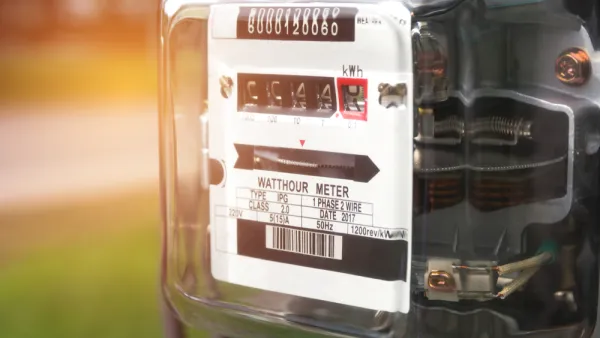
How Much Should Electric Vehicles Be Charged in Lieu of Gas Tax?
Currently, electric vehicles pay a $17.50 annual registration fee in Illinois. A bill to double the 19 cents per gallon gas tax, unchanged in almost 30 years, would also increase the EV fee over 57-fold to $1,000.

Planetizen Federal Action Tracker
A weekly monitor of how Trump’s orders and actions are impacting planners and planning in America.

The state-sanctioned urbicide of Austin
People don’t kill cities. Freeways do.

US to reduce Colorado River water deliveries to Mexico
A new Colorado Treaty amendment reduces Mexico’s Colorado River water allocation by 250,000 acre feet.

Nation's most wind-powered state turns to coal as data centers increase energy demand
For the first time in decades, Iowa has increased its generation of coal power.

NYC cools commuters with city's first rain garden above a bus stop
New York City officials say the plants in the rain garden can absorb 16 gallons of rainwater during heavy storms.

Brightline West’s future may rely on $6 billion federal loan
The company has until Nov. 2 to make a $400 million equity investment into its proposed high-speed rail line.

FREE Course: Walkable City 1: Why Walkability?
After describing his path towards focusing on walkability as the essence of good planning, Jeff Speck marches through his five principal reasons for making more walkable places.
Reinventing Malls: Planning Alchemy—Turning Gray Fields Into Gold
The course focuses on the opportunities and imperatives that shape reinvention of mall sites.

Greater Baltimore Committee
Eagle County Government
Harvard University Graduate School of Design
The Architects Foundation
University of Cincinnati Online
The Pocatello Development Authority
The Urban Renewal Agency of the City of Pocatello
Journal of the American Planning Association