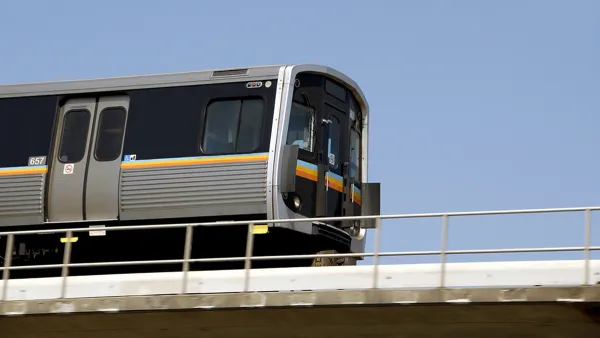
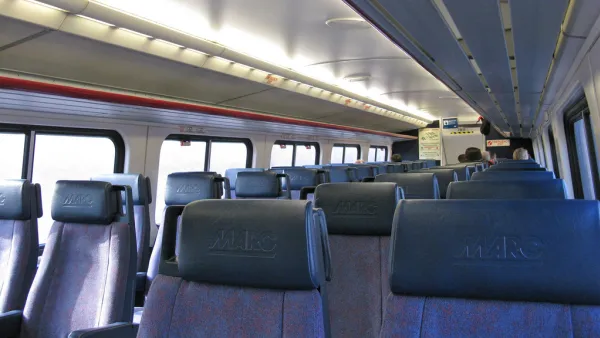
After a stunning financial turnaround and with new political support, MARTA is proposing a massive expansion of commuter rail, with rail links from Atlanta into Fulton and DeKalb counties.


"Over the next seven months, the people at MARTA will quietly button-hole local leaders and state lawmakers — top Republicans included — with the aim of building support for an $8 billion expansion of commuter rail that would transform the region," reports Jim Galloway.
Instead of the circular format of Atlanta's history ("Inside-the-Perimeter, Outside-the-Perimeter, and the rest of Georgia"), MARTA envisions a linear future for the city: "a single file of major economic development up and down what is now Georgia 400, built along a rail line that would link Alpharetta with downtown Atlanta and its airport beyond."
Galloway also notes that recent changes in the political winds at the state level could predict support for the proposal. State Republicans have begun to view the MARTA system as " an essential ingredient in the state’s official economic development kit."
Lori Geary also provides coverage on the proposal, focusing on the challenge of funding the proposal. The article supplements television coverage of the proposal on WSB-TV.
Hat tip to Tanya Snyder at Streetsblog for sharing links to the coverage on the proposal.
Read the full story: MARTA to make an $8 billion pitch to change the face of Atlanta
Transit Oriented Development Spreads to the Suburbs
The Metropolitan Atlanta Rapid Transit Authority (MARTA) is working on mixed-use development plans for a location near Kensington Station, in DeKalb County.

Atlanta Region Residents Support Transit, Taxes to Pay for Transit
The Atlanta Regional Commission recently released the results of its "Metro Atlanta Speaks" public opinion survey last week.
Commuter Rail From Clayton County to Atlanta Planned by MARTA
The Atlanta region could soon gain a commuter rail line similar to those found in New York, Chicago, and Los Angeles.

Planetizen Federal Action Tracker
A weekly monitor of how Trump’s orders and actions are impacting planners and planning in America.

California plans to bury El Niño’s downpour
If the state plays its cards right, it may be able to store a billion acre-feet of El Niño’s water in aquifers.

Desperate measures: Advocates weigh draining Lake Powell to fill Colorado River
Draining the reservoir could reduce evaporation losses by a couple hundred thousand acre-feet.

Mamdani’s pied-à-terre tax survives legal challenge
A panel of judges found that the plaintiffs failed to demonstrate injury as a result of New York City's implementation of the tax.

Eastern Nebraska is running out of electricity
Data centers and electrification are straining eastern Nebraska’s grid, throttling economic development.

Seattle passes record-breaking transit services expansion
Proposition 1 will double the city’s transit tax to add 95,000 more bus trips and preserve 180,000 bus trips annually.

FREE Course: Walkable City 1: Why Walkability?
After describing his path towards focusing on walkability as the essence of good planning, Jeff Speck marches through his five principal reasons for making more walkable places.
Reinventing Malls: Planning Alchemy—Turning Gray Fields Into Gold
The course focuses on the opportunities and imperatives that shape reinvention of mall sites.

City of Rosemead
Rutgers University, Edward J. Bloustein School of Planning and Public Policy
One Hundred Miles
University of Michigan School for Environment and Sustainability (SEAS)
Hunter College, City University of New York (CUNY)
The Architects Foundation
City of Cambridge
Montrose County
The Pocatello Development Authority