The use drones for planning and its related fields has obvious and immediate potential. So far, however, the use of drones lacks a coherent regulatory framework.


According to an article by Katherine Robison, "there is currently no comprehensive framework governing 1) the use of drones in U.S. airspace and 2) the use of data captured by these drones."
What exists instead is a "patchwork" of laws and regulations, including efforts by the Federal Aviation Administration, the National Telecommunications and Information Administration, and state governments.
Robison cites a recently approved law in Florida, called the Freedom from Unwarranted Surveillance Act (SB 766), which specifically prohibits the use of drones to capture images of private property without the owner's consent.
A federal bill [pdf], recently authored by Sen. Edward Markey (D-Mass.) and Rep. Peter Welch (D-Vt.), would fill the gaps in regulation for drones. According to Robison, "[the] Drone Aircraft Privacy and Transparency Act of 2015 include transparency requirements and limits the law enforcement use of drones, requiring either a warrant or exigent circumstances."
Read the full story: REGULATING DRONES AND PRIVACY: SO FAR, A PIECEMEAL APPROACH

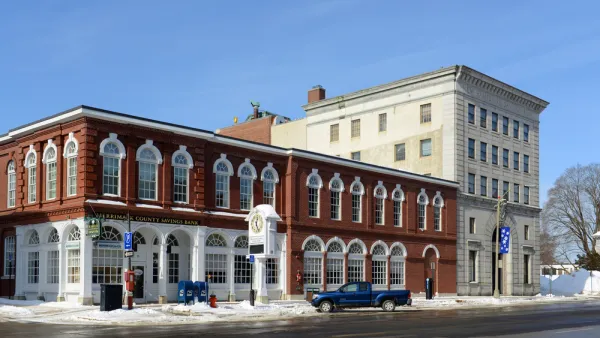
Concord, New Hampshire to Draft a Form-Based Code
Concord will become the latest city to add a form-based code to its menu of development regulations.
Planners Experiment with Unmanned Aerial Systems to Improve Maine Towns
Maine planners are finding new ways to use aerial photos and drone technology to improve transportation and environmental planning.

How Drones Can Improve Planning and Design
In February, the Federal Aviation Administration released rules for the commercial operation of drones that were (to many observers) surprisingly business friendly. A landscape architect imagines the potential of drones for planning and design.

Planetizen Federal Action Tracker
A weekly monitor of how Trump’s orders and actions are impacting planners and planning in America.

California plans to bury El Niño’s downpour
If the state plays its cards right, it may be able to store a billion acre-feet of El Niño’s water in aquifers.

Chicago breaks ground on $3 billion megadevelopment
The new neighborhood, titled Foundry Park, will one day host 3,700 residences.

California High-Speed Rail Authority CEO resigns after $600,000 scandal
Under Ian Choudri, the authority used taxpayer dollars to fund first class flights and trips to nightclubs.

Want to study the Missouri River? Soon, you may need unanimous approval from 10 states
Legislation would require 10 governors’ permission to study or build projects moving water outside the basin.

Desperate measures: Advocates weigh draining Lake Powell to fill Colorado River
Draining the reservoir could reduce evaporation losses by a couple hundred thousand acre-feet.

FREE Course: Walkable City 1: Why Walkability?
After describing his path towards focusing on walkability as the essence of good planning, Jeff Speck marches through his five principal reasons for making more walkable places.
Reinventing Malls: Planning Alchemy—Turning Gray Fields Into Gold
The course focuses on the opportunities and imperatives that shape reinvention of mall sites.

City of Rosemead
Rutgers University, Edward J. Bloustein School of Planning and Public Policy
One Hundred Miles
Hunter College, City University of New York (CUNY)
The Architects Foundation
University of Cincinnati Online
City of Cambridge
Montrose County
The Pocatello Development Authority