With so much focus on local planning in recent years, what opportunities are there for planning at the state and nation-state level? A new study by the Lincoln Institute of Land Policy examines case studies from the United States and Europe.


"Planning at the state and national level leads to more efficient investments in infrastructure, better resilience in the face of climate change, and greater equity in economic development, but most land use planning continues to be done at the local level, according to new research published by the Lincoln Institute of Land Policy."
The Planning for States and Nation-States study, announced on the Lincoln Institute's website, "examines the role of the U.S. federal government and the European Union, and compares land use and spatial planning structures in five U.S. states (Oregon, California, Delaware, Maryland, and New Jersey) and five western European nations (The Netherlands, Denmark, France, U.K., and Ireland)."
Among the findings produced by the study's examination of those case studies, is that the United States' aversion to national planning is hampering its efforts to respond to "challenges like climate change, growing economic disparity, and inadequate infrastructure…"
Read the full story: Planning for States and Nation-States

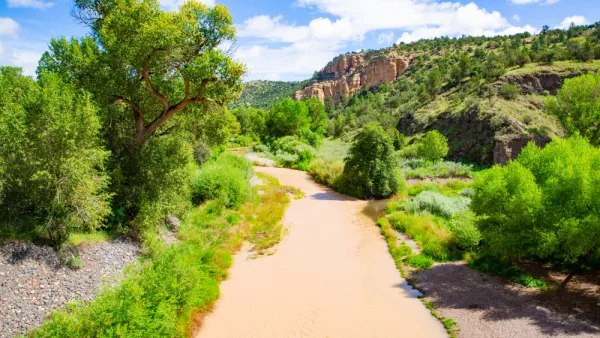
A New Tool for More Flexible and Resilient Water Policies
A new book created by the Sonoran Institute explains how exploratory scenario planning can be useful to prepare for the uncertainty of water in the near- and long-term future.

Cities Have Doubled in Size Globally in the Last 20 Years, Study Says
New research from China finds an incredible rate of urban expansion in North America and China.

An Academic Debate With Very Real Consequences: Land Use Regulations and the Cost of Housing
An article from the journal Urban Studies is inspiring debate and controversy over a year after publication, presenting opposing opinions on fundamental questions about how land use regulation affects the housing market.

Planetizen Federal Action Tracker
A weekly monitor of how Trump’s orders and actions are impacting planners and planning in America.

California plans to bury El Niño’s downpour
If the state plays its cards right, it may be able to store a billion acre-feet of El Niño’s water in aquifers.

Desperate measures: Advocates weigh draining Lake Powell to fill Colorado River
Draining the reservoir could reduce evaporation losses by a couple hundred thousand acre-feet.

California city breaks ground on transit connector
The project includes three mobility hubs and a pedestrian bridge.

After public outcry, Massachusetts city releases housing development tracker
Cambridge’s tracker currently shows 250 housing projects in various stages of development.

40 years after approval, Chicago breaks ground on new park
The park honors Jean Baptiste Point du Sable, the city’s first permanent non-native settler.

FREE Course: Walkable City 1: Why Walkability?
After describing his path towards focusing on walkability as the essence of good planning, Jeff Speck marches through his five principal reasons for making more walkable places.
Reinventing Malls: Planning Alchemy—Turning Gray Fields Into Gold
The course focuses on the opportunities and imperatives that shape reinvention of mall sites.

City of Rosemead
Rutgers University, Edward J. Bloustein School of Planning and Public Policy
One Hundred Miles
Hunter College, City University of New York (CUNY)
The Architects Foundation
University of Cincinnati Online
City of Cambridge
Montrose County
The Pocatello Development Authority