Subway restoration and resilience efforts depend for a large part on federal relief. South Ferry Station, still new when the storm hit, will basically be rebuilt from scratch.


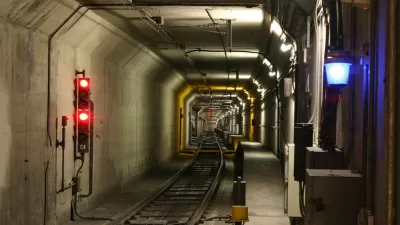
For New York's Metropolitan Transportation Authority, Hurricane Sandy is an ongoing threat. Benjamin Kabak writes, "[a]lthough it's been nearly 2.5 years since the storm and its surge swept through New York, the MTA has repaired only two of the damaged subway tunnels, and the rest are seemingly on borrowed time. The agency simply can't spend the money fast enough and can't take multiple tunnels out of service at the same time."
A good deal of the repair work depends on federal grants: "in a statement released earlier this week, Senators Chuck Schumer and Kirsten Gillibrand along with Congressman Jerry Nadler announced $343 million for South Ferry, a new federal grant in addition to the nearly $200 million in federal dollars they had delivered last winter."
Kabak notes that the press release includes what is "essentially a tacit admission that the MTA's contractors royally screwed up the job the first time around. Due to Sandy, the MTA has a do-over, but it's not one they ever wanted." And there's still the question of readiness when the next Sandy hits.
Read the full story: Feds hand over $343 million in Sandy funds for South Ferry

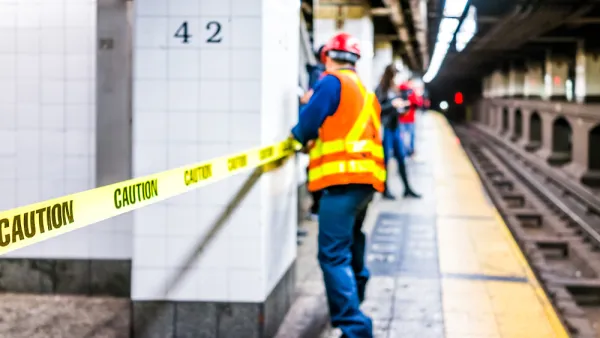
Why New York City's Flooding Its Own Subway Entrances
MTA reassured disoriented New Yorkers that it's flooding subway entrances on purpose, to test barriers that it hopes will guard the system against another Sandy.

In Battery Park City, Public Infrastructure Meets Climate Resilience
A massive project underway in Lower Manhattan seeks to protect the shoreline from future flooding and mitigate the effects of climate change and rising sea levels.

Net Zero Development Coming to New York City
The project, which relies largely on geothermal energy to minimize its carbon footprint, will bring affordable housing and boost storm resilience to an area devastated by Hurricane Sandy.

Planetizen Federal Action Tracker
A weekly monitor of how Trump’s orders and actions are impacting planners and planning in America.

California plans to bury El Niño’s downpour
If the state plays its cards right, it may be able to store a billion acre-feet of El Niño’s water in aquifers.

Chicago breaks ground on $3 billion megadevelopment
The new neighborhood, titled Foundry Park, will one day host 3,700 residences.

California High-Speed Rail Authority CEO resigns after $600,000 scandal
Under Ian Choudri, the authority used taxpayer dollars to fund first class flights and trips to nightclubs.

Want to study the Missouri River? Soon, you may need unanimous approval from 10 states
Legislation would require 10 governors’ permission to study or build projects moving water outside the basin.

Desperate measures: Advocates weigh draining Lake Powell to fill Colorado River
Draining the reservoir could reduce evaporation losses by a couple hundred thousand acre-feet.

FREE Course: Walkable City 1: Why Walkability?
After describing his path towards focusing on walkability as the essence of good planning, Jeff Speck marches through his five principal reasons for making more walkable places.
Reinventing Malls: Planning Alchemy—Turning Gray Fields Into Gold
The course focuses on the opportunities and imperatives that shape reinvention of mall sites.

City of Rosemead
Rutgers University, Edward J. Bloustein School of Planning and Public Policy
One Hundred Miles
Hunter College, City University of New York (CUNY)
The Architects Foundation
University of Cincinnati Online
City of Cambridge
Montrose County
The Pocatello Development Authority