Philadelphia's Washington Avenue experienced 915 car crashes between 2010 and 2013. The city wants to minimize risk in its redesign, but lacks the space to install every suggested improvement.


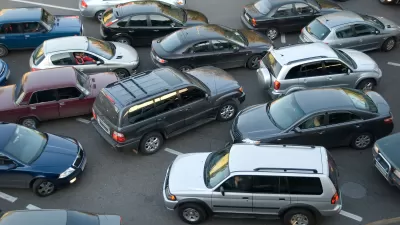
After experiencing a high rate of car crashes, many involving pedestrians, Philadelphia will redesign Washington Avenue. Compromise from a "complete streets" ideal is expected. From the article: "Median islands aren't currently on the table for the Washington Ave redesign, because a turning lane has been planned for that space. As city planner Jeannette Brugger pointed out to Ashley Hahn this fall, when she asked about adding a buffered bike lane, there's only so much space on the street."
A reduction in vehicle capacity is also on the table, which planners hope will curb the street's high accident potential. "Even with just one lane in each direction, a four-way intersection has 32 potential conflict points for vehicles to collide with one another, and 24 potential conflict points for vehicles to collide with pedestrians. So reducing the number of lanes from five to three, as the Planning Commission is proposing, would reduce the number of potential conflict points exponentially and dramatically improve the odds for pedestrians."
Read the full story: What makes Washington Avenue so dangerous?


Why a Complete Streets Makeover Went Awry in Philadelphia
The city pulled the plug on a proposed street redesign after community groups criticized the public engagement process for not listening to all local voices.
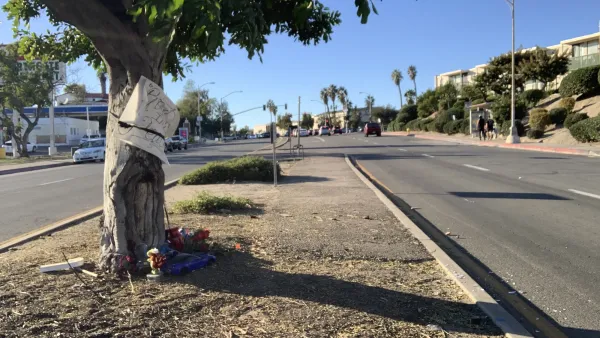
San Diego’s Car-centered Planning is Killing Children
Like most American cities, San Diego’s planning choices hold a gruesome legacy. Why are we okay with that?

Pedestrian Deaths Drop, Remain Twice as High as in 2009
Fatalities declined by 4 percent in 2024, but the U.S. is still nowhere close to ‘Vision Zero.’

Planetizen Federal Action Tracker
A weekly monitor of how Trump’s orders and actions are impacting planners and planning in America.

California plans to bury El Niño’s downpour
If the state plays its cards right, it may be able to store a billion acre-feet of El Niño’s water in aquifers.

Chicago breaks ground on $3 billion megadevelopment
The new neighborhood, titled Foundry Park, will one day host 3,700 residences.

California High-Speed Rail Authority CEO resigns after $600,000 scandal
Under Ian Choudri, the authority used taxpayer dollars to fund first class flights and trips to nightclubs.

Want to study the Missouri River? Soon, you may need unanimous approval from 10 states
Legislation would require 10 governors’ permission to study or build projects moving water outside the basin.

Desperate measures: Advocates weigh draining Lake Powell to fill Colorado River
Draining the reservoir could reduce evaporation losses by a couple hundred thousand acre-feet.

FREE Course: Walkable City 1: Why Walkability?
After describing his path towards focusing on walkability as the essence of good planning, Jeff Speck marches through his five principal reasons for making more walkable places.
Reinventing Malls: Planning Alchemy—Turning Gray Fields Into Gold
The course focuses on the opportunities and imperatives that shape reinvention of mall sites.

City of Rosemead
Rutgers University, Edward J. Bloustein School of Planning and Public Policy
One Hundred Miles
Hunter College, City University of New York (CUNY)
The Architects Foundation
University of Cincinnati Online
City of Cambridge
Montrose County
The Pocatello Development Authority