In San Francisco at this time last year, Google bus protestors and Ellis Act rage were making the news everyday. The City seems a little more...adjusted these days.


"San Francisco’s antitech movement, it appears, has fizzled before it ever really took off," according to an article by Kristen V. Brown.
Brown cites a source from inside the protest movement to deliver a postmortem:
"'As it turned out, after the media had digested our actions, there was no groundswell of support from young people or everyday residents of San Francisco,' said a representative of the Counterforce, an anonymous collective and one of the Bay Area's most theatrical tech protest groups. 'By the middle of 2014, it was clear that only the same small groups would keep acting against the tech industry, and gradually the momentum was halted.'"
The anti-tech movement focused some of its ire toward planning related policy issues, such as Ellis Act evictions and the use of private, chartered buses at public transit stops. Brown notes that major policy initiatives supported by protest groups have, in large part, failed. For instance, "Proposition G, a ballot measure intended to curb real estate speculation that drives up housing costs, and an Assembly bid by Supervisor David Campos, probably the movement’s greatest political ally, both failed at the polls in November." There is also the poll announced earlier this month by the Office of Mayor Ed Lee finding widespread support for the tech industry among San Francisco residents.
Read the full story: Is the antitech movement obsolete?

Poll: San Francisco Loves the Tech Industry
San Francisco Mayor Ed lee is so far running unopposed for re-election next Fall, which means that voters won't be offered a chance for a referendum on his support for the tech industry.

Evaluating the 2011 'Twitter Tax Break' Along San Francisco's Troubled Market Street
The 2011 "Twitter tax break" was controversial at the time, and remains so to this day. New offices and employees have filled the corridor of Market Street where the tax break is in effect, but massive challenges persist.
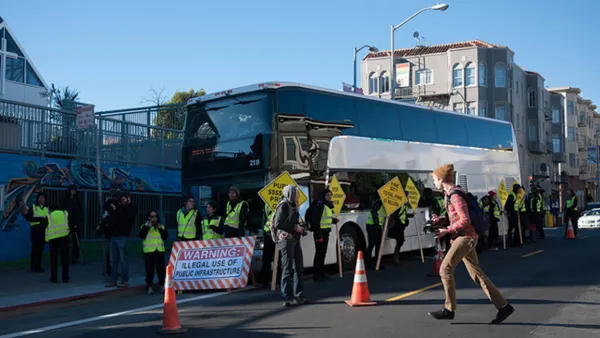
The Downside of Removing Tech Buses from Neighborhoods
A new study has shown that moving tech shuttle stops from neighborhoods to conform to a new "hub plan" would result in a drop in bus ridership, with most former riders resorting to driving their own vehicles to their Silicon Valley workplaces.

Planetizen Federal Action Tracker
A weekly monitor of how Trump’s orders and actions are impacting planners and planning in America.

Amtrak, CN end decades-long dispute with eight-year agreement
The new operating agreement establishes an updated framework for the companies to work together, including processes to resolve disputes.

Judges permit Denver to divert 77,000 acre feet from the Colorado River for reservoir expansion
Overuse and climate change have caused the Colorado River’s water levels to plummet.

Boston has spent millions making the Green Line more accessible — and there’s no end in sight
While the city has invested millions into expanding and adding platforms to the Green Line to make it more accessible, new train cars set to arrive next year will be too tall for disabled passengers to board without raising the current platforms.

Idaho may see an 18% drop in federal surface transit funding — the largest estimated cut in the US
Transit systems in rural communities are much more reliant on federal funding to provide their services.

How ‘post-disaster gentrification’ alters neighborhoods after natural calamities
After hurricanes, fires or other calamities, the original residents of a community are often replaced by younger, wealthier residents.

FREE Course: Walkable City 1: Why Walkability?
After describing his path towards focusing on walkability as the essence of good planning, Jeff Speck marches through his five principal reasons for making more walkable places.
Reinventing Malls: Planning Alchemy—Turning Gray Fields Into Gold
The course focuses on the opportunities and imperatives that shape reinvention of mall sites.

City of Wisconsin Rapids
Harvard University Graduate School of Design
KFH Group Inc.
The Architects Foundation
University of Cincinnati Online
The Pocatello Development Authority
The Urban Renewal Agency of the City of Pocatello