Political leaders in San Diego have spent years characterizing the city's NFL team as a regional asset, requiring a new stadium to keep in place. A column debunks some of the logic behind how and why behind some of that reasoning.


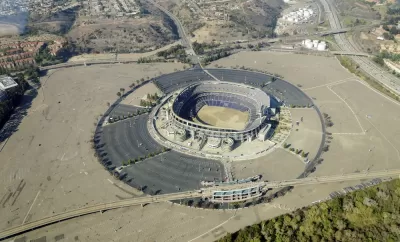
Scott Lewis writes a columned aimed at dispelling myths surrounding the development of a new NFL stadium to house the Chargers in San Diego. "Every time I talk about this story, whether on the radio, at a party or on Twitter, the same simple responses come up. Here’s why we need to retire the most common ones," writes Lewis.
The four myths Lewis tackles:
- "Why don’t they get a bunch of private investors to pay for a new stadium?"
- "The fans who care about football can pay for it."
- "They can combine it with a soccer stadium. (Or the Olympics!) Or the Convention Center."
- "We’ll get Super Bowls regularly if we build it."
Click through to the article to hear the counterarguments for each of these points.
Read the full story: Four Myths About a Chargers Stadium That Must Die

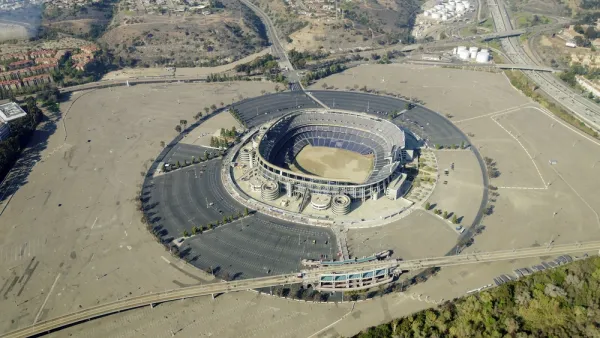
San Diego Mayor Supports New Football Stadium
San Diego mayor, Kevin Faulconer, calls for voters to support $1.8 billion new football stadium.
3 NFL Teams File Walking Papers
Three teams will attempt to leave town. Resolution of the contentious political situations could be coming very soon.
Parsing San Diego's Misguided Waterfront Plans
As Seattle considers ways to improve its waterfront, local architect and urban planner Mark Hinshaw evaluates a conflict brewing 1,250 miles to the south, for a lesson on what not to do with valuable downtown waterfront real estate.

Planetizen Federal Action Tracker
A weekly monitor of how Trump’s orders and actions are impacting planners and planning in America.

Amtrak, CN end decades-long dispute with eight-year agreement
The new operating agreement establishes an updated framework for the companies to work together, including processes to resolve disputes.

Judges permit Denver to divert 77,000 acre feet from the Colorado River for reservoir expansion
Overuse and climate change have caused the Colorado River’s water levels to plummet.

Boston has spent millions making the Green Line more accessible — and there’s no end in sight
While the city has invested millions into expanding and adding platforms to the Green Line to make it more accessible, new train cars set to arrive next year will be too tall for disabled passengers to board without raising the current platforms.

Idaho may see an 18% drop in federal surface transit funding — the largest estimated cut in the US
Transit systems in rural communities are much more reliant on federal funding to provide their services.

How ‘post-disaster gentrification’ alters neighborhoods after natural calamities
After hurricanes, fires or other calamities, the original residents of a community are often replaced by younger, wealthier residents.

FREE Course: Walkable City 1: Why Walkability?
After describing his path towards focusing on walkability as the essence of good planning, Jeff Speck marches through his five principal reasons for making more walkable places.
Reinventing Malls: Planning Alchemy—Turning Gray Fields Into Gold
The course focuses on the opportunities and imperatives that shape reinvention of mall sites.

Harvard University Graduate School of Design
KFH Group Inc.
Greater Baltimore Committee
The Architects Foundation
University of Cincinnati Online
The Pocatello Development Authority
The Urban Renewal Agency of the City of Pocatello