Researchers at the Institute for Quality Communities at the University of Oklahoma prepared a set of images to show the indelible impact of mid-20th century urban renewal on Midwestern cities.


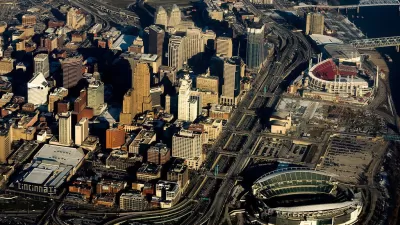
"60 years has made a big difference in the urban form of American cities," writes Shane Hampton to experiment a series of sliding photos that allow side-by-side comparison of Midwestern cities from the 1950s to today.
"The most rapid change occurred during the mid-century urban renewal period that cleared large tracts of urban land for new highways, parking, and public facilities or housing projects. Fine-grained networks of streets and buildings on small lots were replaced with superblocks and megastructures."
Cities portrayed in the striking set of sliding photos: Cincinnati, Detroit, St. Louis, Minneapolis, Milwaukee, Indianapolis, Cleveland, and Columbus.
Read the full story: 60 Years of Urban Change: Midwest

Bike-Share Spreads Across Sprawling Midwest
Bike-share is continuing its march towards world domination, with seemingly every large Midwestern American city now jumping on the bike lending bandwagon, reports Angie Schmitt.

Mapping Tool Enables Housing Action in Detroit and Beyond
A web tool that helped Detroit develop a housing plan may ultimately provide public data on every parcel in the country.
A Closer Look At Growth Data Showing An Urban Revival
On April 5, the U.S. Census Bureau released growth data from April 2010 to July 2011 showing that for the first time in 20 years, urban growth surpassed exurban growth. Yonah Freemark takes a closer look at the data for 21 metropolitan areas.

Planetizen Federal Action Tracker
A weekly monitor of how Trump’s orders and actions are impacting planners and planning in America.

California plans to bury El Niño’s downpour
If the state plays its cards right, it may be able to store a billion acre-feet of El Niño’s water in aquifers.

Chicago breaks ground on $3 billion megadevelopment
The new neighborhood, titled Foundry Park, will one day host 3,700 residences.

California High-Speed Rail Authority CEO resigns after $600,000 scandal
Under Ian Choudri, the authority used taxpayer dollars to fund first class flights and trips to nightclubs.

Want to study the Missouri River? Soon, you may need unanimous approval from 10 states
Legislation would require 10 governors’ permission to study or build projects moving water outside the basin.

Desperate measures: Advocates weigh draining Lake Powell to fill Colorado River
Draining the reservoir could reduce evaporation losses by a couple hundred thousand acre-feet.

FREE Course: Walkable City 1: Why Walkability?
After describing his path towards focusing on walkability as the essence of good planning, Jeff Speck marches through his five principal reasons for making more walkable places.
Reinventing Malls: Planning Alchemy—Turning Gray Fields Into Gold
The course focuses on the opportunities and imperatives that shape reinvention of mall sites.


City of Rosemead
Rutgers University, Edward J. Bloustein School of Planning and Public Policy
One Hundred Miles
Hunter College, City University of New York (CUNY)
The Architects Foundation
University of Cincinnati Online
City of Cambridge
Montrose County
The Pocatello Development Authority