An article in Treehugger explains the public safety benefits of protected bike lanes by appealing to common sense.


"In just about every way you can measure the topic, protected bike lanes have been linked to more and safer bicycling," writes Zachary Shahan.
The benefits of bike lanes extend beyond the safety of bikers, according to Shahan, to pedestrians as well: "However, protected bike lanes aren’t only protected from automobile traffic; they’re also separated from sidewalks (at least via paint, if not curbs, bushes, trees, distance, or barriers). Naturally, this protects pedestrians from bicyclists, but in a number of obvious and subtle ways, this also protects pedestrians from cars. In some areas, the improvement is dramatic."
Although the Shahan cites data to back up his claims about improved pedestrian safety on roads with protected bike lanes, much of the article avoids the technical jargon that is often necessary in writing about street configuration. Instead, Shahan relies on his own, common sense ideas and experience about why multi-modal infrastructure benefits safety.
Read the full story: Protected bike lanes also help protect pedestrians... in so many ways
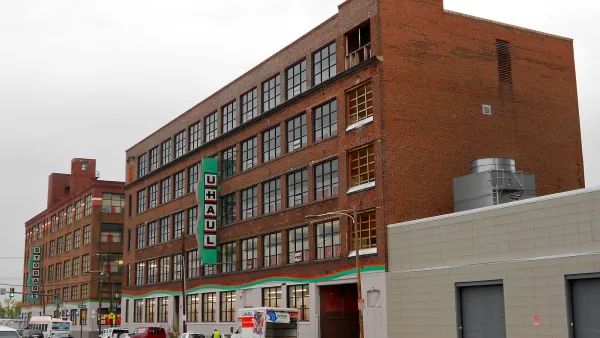
Why a Complete Streets Makeover Went Awry in Philadelphia
The city pulled the plug on a proposed street redesign after community groups criticized the public engagement process for not listening to all local voices.
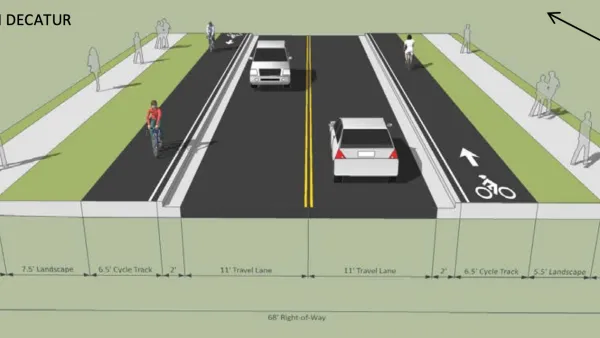
Separated Bike Lanes, Traffic Calming Coming to Decatur Street
Decatur's Church Street is set to undergo a transformation that will reduce traffic lanes, add cycletracks, and widen sidewalks in an effort to make the corridor more 'people-friendly.'
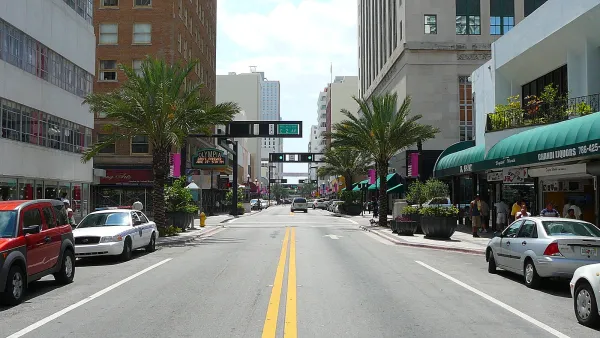
Miami Funds Protected Bike Lanes With E-Scooter Fees
The city, which has some of the nation's most dangerous streets for pedestrians and cyclists, is installing 3 miles of new bike lanes and pedestrian ramps on some of its busiest downtown corridors.

Planetizen Federal Action Tracker
A weekly monitor of how Trump’s orders and actions are impacting planners and planning in America.

California plans to bury El Niño’s downpour
If the state plays its cards right, it may be able to store a billion acre-feet of El Niño’s water in aquifers.

Desperate measures: Advocates weigh draining Lake Powell to fill Colorado River
Draining the reservoir could reduce evaporation losses by a couple hundred thousand acre-feet.

Mamdani’s pied-à-terre tax survives legal challenge
A panel of judges found that the plaintiffs failed to demonstrate injury as a result of New York City's implementation of the tax.

Eastern Nebraska is running out of electricity
Data centers and electrification are straining eastern Nebraska’s grid, throttling economic development.

Seattle passes record-breaking transit services expansion
Proposition 1 will double the city’s transit tax to add 95,000 more bus trips and preserve 180,000 bus trips annually.

FREE Course: Walkable City 1: Why Walkability?
After describing his path towards focusing on walkability as the essence of good planning, Jeff Speck marches through his five principal reasons for making more walkable places.
Reinventing Malls: Planning Alchemy—Turning Gray Fields Into Gold
The course focuses on the opportunities and imperatives that shape reinvention of mall sites.

City of Rosemead
Rutgers University, Edward J. Bloustein School of Planning and Public Policy
One Hundred Miles
University of Michigan School for Environment and Sustainability (SEAS)
Hunter College, City University of New York (CUNY)
The Architects Foundation
City of Cambridge
Montrose County
The Pocatello Development Authority