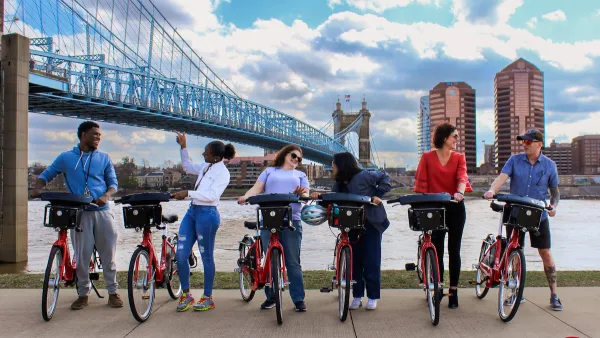
With a somewhat-surprise launch last week, the Cincy Red Bike program has hit the streets in Cincinnati. Along with the program's launch come previously unknown details about the program.


"Those eager to sign-up for the region’s first bike share program found out at some point last week that the system was open," reports Randy A. Simes for UrbanCincy. "It marked the first time anyone was able to purchase annual memberships through Cincy Red Bike, and it also was the first time rates were revealed."
"What those early members found out was that annual memberships cost $80 and daily rentals will cost $8. UrbanCincy has revealed that both of these rates are among the highest of B-cycle’s markets, but comparable to the other large cities served by the nation’s largest bike share company." Members of Cincy Red Bike will also gain access to rentals in Austin, Denver, Forth Worth, Indianapolis, and San Antonio.
The UrbanCincy coverage includes more details about some unique perks offered Cincy Red Bike members as well as a map of the initial bike share facilities around the city.
Read the full story: With Membership Rates Set, Cincy Red Bike to Begin Operations Monday
Bikes Early Ridership Outpaces Expectations for Cincy Red Bikes
A surprise opening in September has given way to ridership that exceeds expectations for Cincinnati's fledgling Red Bikes bikeshare system.
Cincinnati Bike Share System To Relaunch May 13
The Red Bike system suspended operations in March, but has since raised funds through a private campaign to resume service.
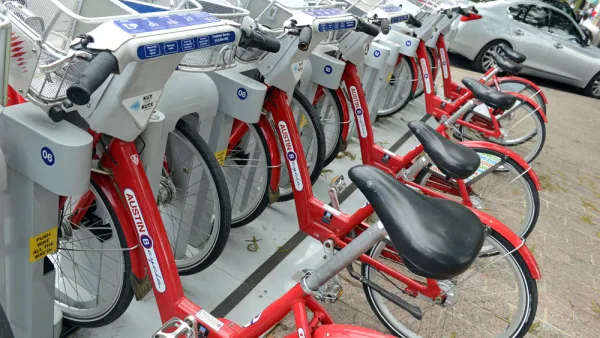
Transit, Bikeshare Integration Planned in Austin
Under a plan scheduled for implementation later this year, a transit pass will mean access to the city's bikeshare system.

Planetizen Federal Action Tracker
A weekly monitor of how Trump’s orders and actions are impacting planners and planning in America.

Eastern Nebraska is running out of electricity
Data centers and electrification are straining eastern Nebraska’s grid, throttling economic development.

California High-Speed Rail Authority picks trainset manufacturer
The California High-Speed Rail Authority aims to start servicing passengers by 2033.

States are counting on battery farms. Some towns don’t want them.
While fire safety has improved, some communities are still wary.

Dallas releases zoning code overhaul to officials
The drafted overhaul is over 400 pages long.

NYC renovations for dangerous, ‘mercilessly crammed’ street delayed until 2027
Construction was supposed to begin this fall.

FREE Course: Walkable City 1: Why Walkability?
After describing his path towards focusing on walkability as the essence of good planning, Jeff Speck marches through his five principal reasons for making more walkable places.
Reinventing Malls: Planning Alchemy—Turning Gray Fields Into Gold
The course focuses on the opportunities and imperatives that shape reinvention of mall sites.

City of Rosemead
Rutgers University, Edward J. Bloustein School of Planning and Public Policy
One Hundred Miles
University of Michigan School for Environment and Sustainability (SEAS)
Hunter College, City University of New York (CUNY)
The Architects Foundation
City of Cambridge
The Pocatello Development Authority
The Urban Renewal Agency of the City of Pocatello