A new study finds that economic inequality is a national problem, evidenced by the access of college educated residents to quality of life indicators in cities all over the country—not just San Francisco, New York, and Boston.


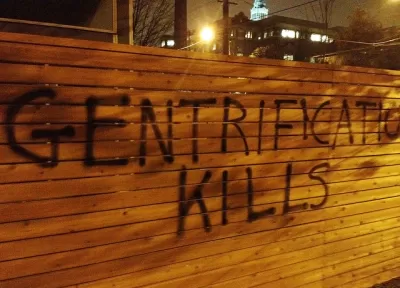
Emily Badger shares news of a new study finding that "college graduates in America aren't simply gaining access to higher wages. They're gaining access to high-cost cities like New York or San Francisco that offer so much more than good jobs: more restaurants, better schools, less crime, even cleaner air."
The study is by Stanford economist Rebecca Diamond, who explores "economic well-being inequality." Diamond is quoted in the story explaining the difference this metric makes: "With wage inequality, you could just observe the average wage of a college graduate, and the average wage of a high school graduate….But then on top of that, college graduates also live in the nicest cities in the country. They’re getting more benefits, even net of fact that they’re paying higher housing costs."
Read the full story: A ‘nationwide gentrification effect’ is segregating us by education
What Lies Behind America's Rising Inequality
Wage inequality does not tell the whole picture of the growing income inequality in the United States, writes Richard Florida, who examines the myriad other factors that may be driving this trend.
Is Inequality Destroying American Cities?
A recent video claimed that high income inequality is the “Thing That Will Destroy Our Cities.” Is this true?
Census Releases New Interactive Dashboard to Identify Underserved Communities
The new "My Community Explorer" interactive dashboard is intended to help drive data-based solutions to inequality in and between communities.

Planetizen Federal Action Tracker
A weekly monitor of how Trump’s orders and actions are impacting planners and planning in America.

California plans to bury El Niño’s downpour
If the state plays its cards right, it may be able to store a billion acre-feet of El Niño’s water in aquifers.

Desperate measures: Advocates weigh draining Lake Powell to fill Colorado River
Draining the reservoir could reduce evaporation losses by a couple hundred thousand acre-feet.

Mamdani’s pied-à-terre tax survives legal challenge
A panel of judges found that the plaintiffs failed to demonstrate injury as a result of New York City's implementation of the tax.

Eastern Nebraska is running out of electricity
Data centers and electrification are straining eastern Nebraska’s grid, throttling economic development.

Seattle passes record-breaking transit services expansion
Proposition 1 will double the city’s transit tax to add 95,000 more bus trips and preserve 180,000 bus trips annually.

FREE Course: Walkable City 1: Why Walkability?
After describing his path towards focusing on walkability as the essence of good planning, Jeff Speck marches through his five principal reasons for making more walkable places.
Reinventing Malls: Planning Alchemy—Turning Gray Fields Into Gold
The course focuses on the opportunities and imperatives that shape reinvention of mall sites.

City of Rosemead
Rutgers University, Edward J. Bloustein School of Planning and Public Policy
One Hundred Miles
University of Michigan School for Environment and Sustainability (SEAS)
Hunter College, City University of New York (CUNY)
The Architects Foundation
City of Cambridge
Montrose County
The Pocatello Development Authority